8 Healthcare Email Examples That Bring Patients Back
Eight emails a practice can send, in the order a patient meets them, each with a subject line and a few lines of copy you can adapt.
Most practices know they should email their patients. What they don’t have is the actual emails: what to say, when to send it, and what to put in the subject line without breaking anyone’s privacy. These are healthcare email examples built for patient engagement, written as templates you can adapt.
So below are eight healthcare email examples, in the order a patient meets them, each with a subject line and a few lines of copy.
Start with the list you already have
We learned how much an old list is worth with a fiber supplement brand. The obvious move was paid social. We didn’t start there. We started with an email campaign to people who had already bought, and it revived that old customer base before we spent anything on ads. Only then did we run ads, and on Amazon, where the product is actually bought. That’s how the brand was moved into profit.
A practice has the same thing sitting in its records: hundreds of people who already trust you and just stopped hearing from you. Every email below is aimed at someone like that, someone you already paid to get.
Before you send anything: the HIPAA basics
Email to patients is allowed. HHS says providers can email patients about their health and treatment as long as they use reasonable safeguards, like checking the address and limiting what goes into an unencrypted message. It also says a patient can ask to be reached some other way, and you should respect that.
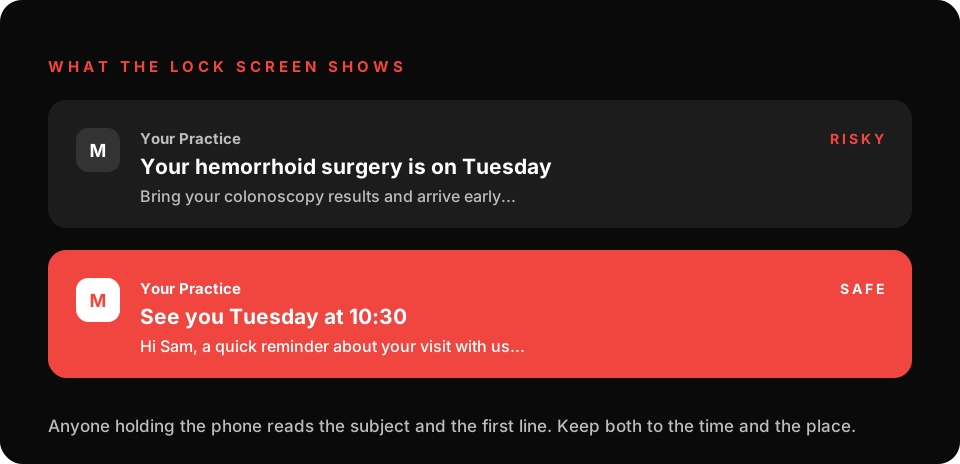
In practice that comes down to a few habits. Keep diagnoses and treatment details out of the subject line and the preview text, because that’s what shows on a lock screen. Send from a HIPAA compliant email tool that signs a business associate agreement (a BAA) with you, never from a personal inbox. And ask for consent on the intake form: which address, and whether they’re happy to get email at all.
Promotional email is a separate question. HHS treats most marketing under the HIPAA Privacy Rule as needing the patient’s written authorization, with exceptions for things like your own services and their treatment. Where an email sits is a call for whoever handles your compliance. And any commercial email also has to follow the FTC’s CAN-SPAM rules: an honest subject line, your postal address and a working opt out.
Not sure your email tool is HIPAA compliant, or who signs the BAA?
Let us set it up for you →8 healthcare email examples, with copy you can use
- The welcome before the first visit. Send it as soon as they book.
Subject: “Your first visit on {day}: what to bring”
“Hi {first name}, we’re looking forward to meeting you on {day} at {time}. Bring your insurance card and a list of any medicines you take. Parking is {where}, and the visit takes about {length}.” - The appointment reminder. Two days before, so there’s still time to move it.
Subject: “See you {day} at {time}”
“Hi {first name}, a quick reminder that you’re booked with Dr. {name} on {day} at {time}. If that no longer works, just reply to this email or call {phone} and we’ll find you another time.” - The cost and financing explainer. After a consultation where they didn’t book yet.
Subject: “The numbers you asked about”
“Hi {first name}, here’s the cost in plain terms: {price range}, what’s included, and what insurance usually covers. If paying monthly is easier, we offer that through {financing partner}. Reply with any question and we’ll answer it straight.” - The “how are you feeling” email. Two days after the visit, from a named person.
Subject: “How are you feeling, {first name}?”
“It’s {staff name} from Dr. {name}’s office. We wanted to check how you’ve been since {day}. If anything feels off, or there’s a question you forgot to ask, reply here and a real person will get back to you today.” - The review request. A few days after the visit, to every patient. Good or bad, the review is theirs to write.
Subject: “Would you share how it went?”
“Hi {first name}, thanks again for coming in on {day}. If you have a minute, a short Google review helps other people find us: {link}. Write whatever you honestly think, and if you mention what you came in for, only share what you’re comfortable with.” Never offer anything in return; Google’s guidance on getting more reviews calls that strictly prohibited. - The seasonal check in. When the season matters to what you treat, or when benefits are about to reset.
Subject: “Before your benefits reset in January”
“Hi {first name}, if you’ve already met your deductible this year, a visit before December 31 may cost you less than the same visit in January. Here are the times we still have open: {link}.” - The rebook for a lapsed patient. Once they’re overdue for the visit you’d normally expect.
Subject: “It’s been a while, {first name}”
“We noticed it’s been some time since we last saw you. No pressure at all, but if you’re due a visit, here are a few open times this month: {link}. And if you’ve moved to another practice, we’d honestly like to know why.” - The referral thank you. To the doctor who sent the patient, the week you see them.
Subject: “Thank you for the referral”
“Dr. {name}, thank you for sending a patient our way. We saw them on {day}, and our notes are on their way to you through {secure channel}. If anything changes in their care, you’ll hear from us first.”
Notice what’s missing from all eight: the condition. None of the subjects or first lines say what anyone is being treated for, and the referral email leaves the patient’s name out entirely and sends the notes through a secure channel instead.
The welcome works even better paired with insurance verification before the first visit, so the patient walks in already knowing what they’ll pay.
No time to write and schedule all eight?
Let us write them for you →When each one goes out
Lay them out on a calendar and the shape is obvious. Two emails get the patient to the first visit. Everything else happens after it, which is exactly where most practices go quiet.
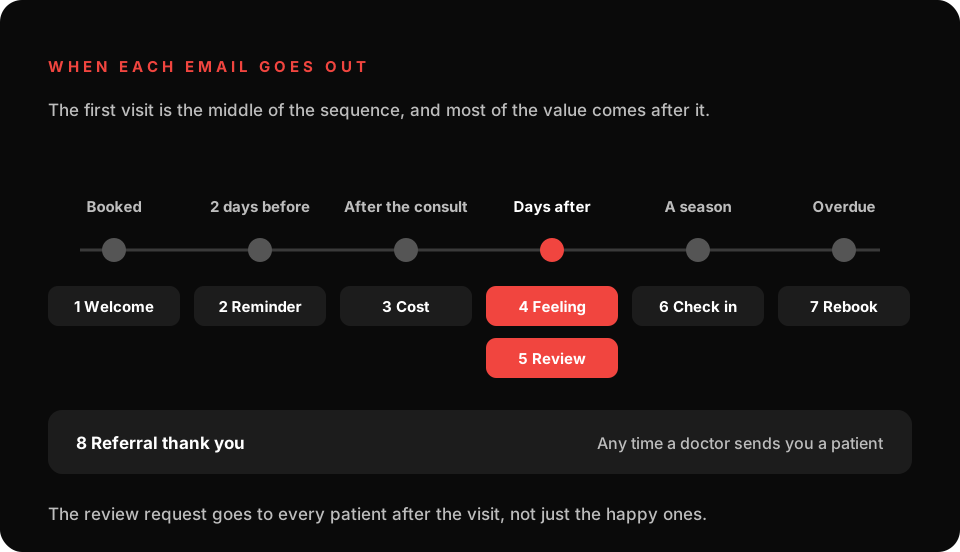
If you can only set up two this month, make it the reminder and the lapsed patient rebook. The reminder stops empty chairs. The rebook brings back people who already know where you are and how you work.
Not sure who in your records is overdue?
Let us find them for you →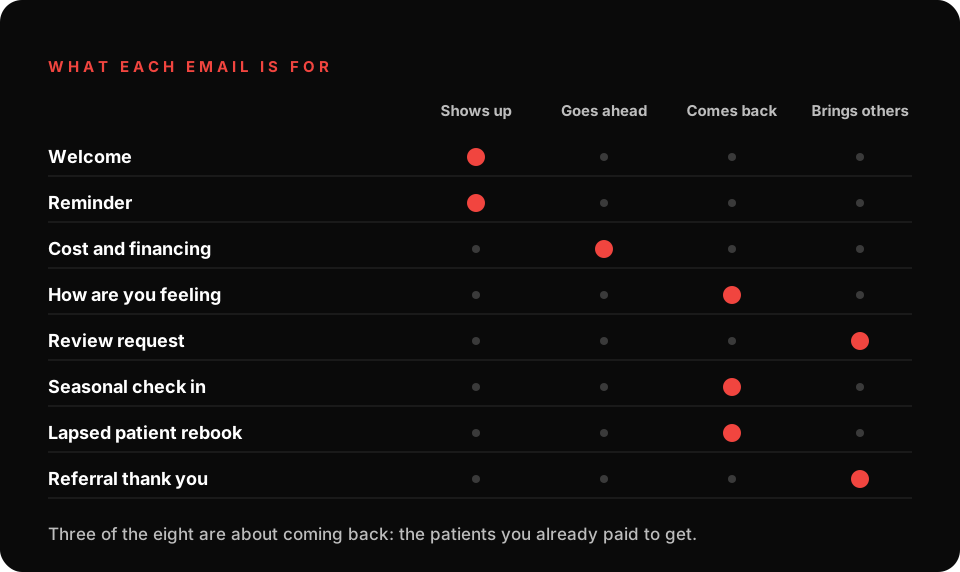
Write them like a person, not a newsletter
The emails that work in a practice look like something a person typed. Plain text, a first name at the top, a real name at the bottom, and a reply that lands with someone who reads it. A designed newsletter with a banner and three columns looks like marketing, and patients treat it that way.
Keep each one to a single job. The reminder reminds. The review request asks for a review. Once you start squeezing an offer into the check in email, the patient stops reading the check in. And set them up to send on their own from a HIPAA compliant tool, because the follow up that depends on someone remembering is the one that doesn’t happen.
Find out which patients you could win back.
Six questions, then learn about the marketing opportunities in your area, including what your existing patient list could be doing for you.
Get your assessment →