Patient Acquisition: How New Patients Choose a Doctor
A new patient decides between two or three practices long before they call. Here’s how that choice gets made, and where most practices lose it.
Every practice wants more new patients, and most of them try to get there by being seen in more places. But being seen is only the first step. A new patient looks at two or three practices, compares them, and calls one. Patient acquisition that starts with how patients choose works on all of those steps, not just the first.
So this is how that choice actually gets made, where practices lose people along the way, and what we do about it.
What patient acquisition actually is
Patient acquisition is getting someone who has never been to your practice to choose you, come in, and go ahead with the treatment. The first visit is where most practices stop counting, and it’s exactly where things get messy.
That sounds obvious, but it changes what you measure. A practice that counts enquiries will happily pay for a hundred of them that never book. A practice that counts patients who actually go ahead finds out very quickly which of its marketing is working and which is just noise. That’s the number we report on.
How new patients choose a doctor
Nobody wakes up wanting a doctor. They wake up with a problem. Then they search for it, ask an AI, or ask a friend, and they end up with a shortlist of two or three names. They check each one, and they contact whichever looks right and is easiest to reach.
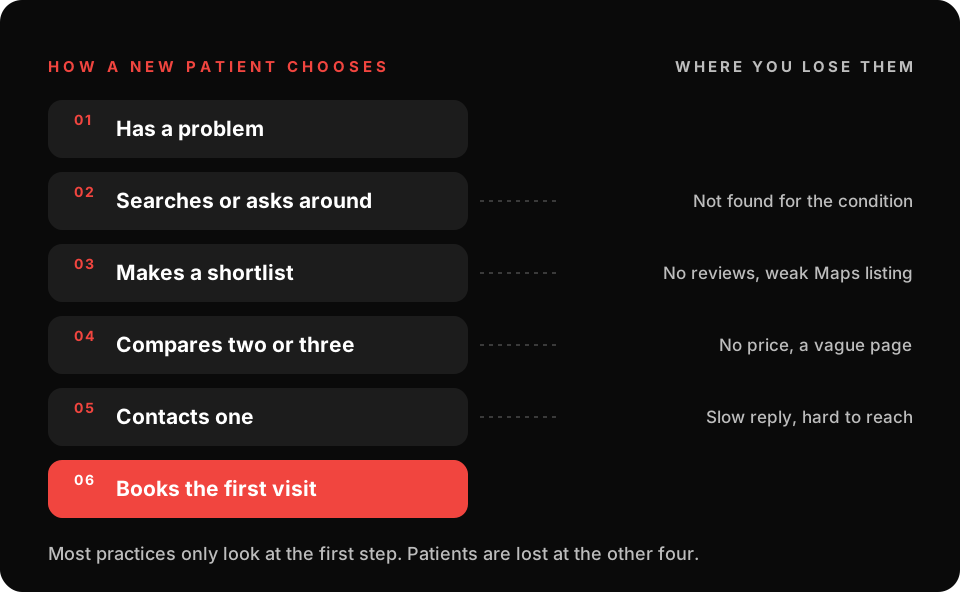
Look at where the patients go missing. Hardly any of it happens at the search. A practice that isn’t found for the condition never makes the list. One with a thin Maps listing and three reviews gets dropped from it. One with no price and a vague page loses the comparison. And one that takes a day to call back loses the patient who was ready to book.
Winning the shortlist
By the time someone is comparing you with the practice down the street, your skill is almost invisible to them. They can’t judge a surgeon’s hands from a website. What they can judge is whether you seem to understand their problem, what it’ll cost, what other patients say, and how easy you are to reach.
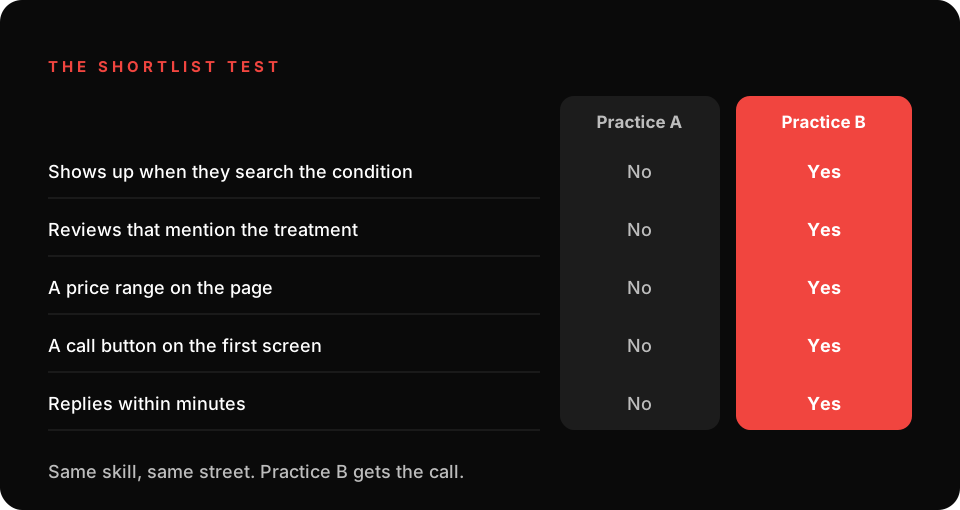
Two practices with the same skill on the same street can get very different numbers of new patients for exactly these reasons. None of these need a bigger budget, just someone to fix them.
After the first visit, it depends on why they came
Getting someone in for a consultation isn’t the same as getting them to go ahead. What happens after that first visit depends almost entirely on what brought them in.
A colorectal surgeon we work with put it simply. When a patient comes in with pain and bleeding, they book the surgery. When it’s just pain, a lot of them pull back. They try a cream, wait it out, and hope it goes away. Same condition, same surgeon, a completely different outcome.
The exception is pain that gets in the way of their life. Once it stops them walking properly, working or sleeping, they go ahead too. So the line comes down to whether the problem scares them or takes something away from them. Pain they can live with, they live with.
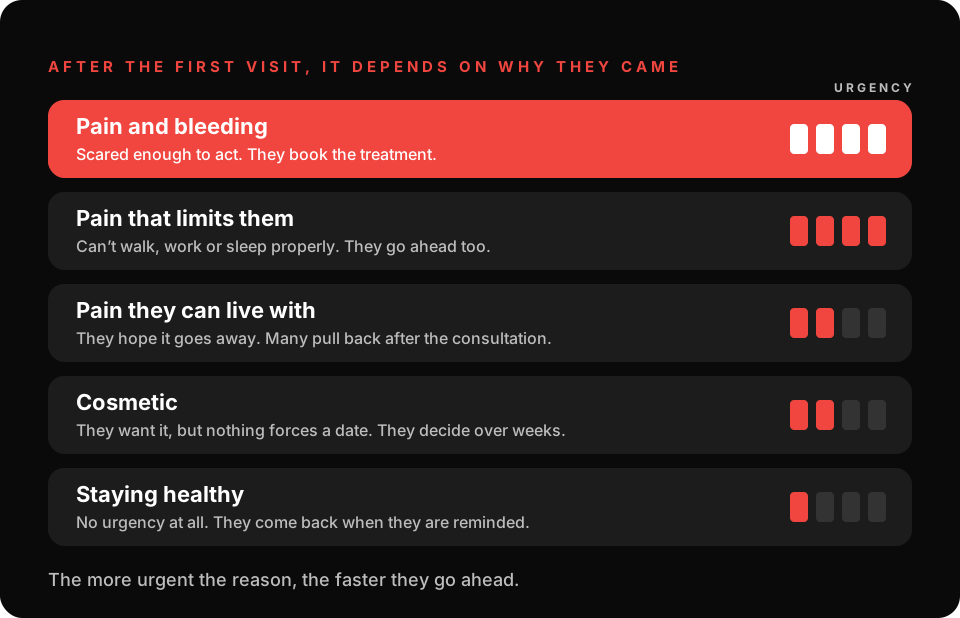
So the follow up can’t be the same for everyone.
- Pain and bleeding, or pain that stops them doing things. They’re ready. Be clear about the next step and don’t make them wait three weeks for a slot.
- Pain they can live with. Stay in touch. Explain what the procedure involves and what recovery looks like, so the next step feels smaller than the pain they’re putting up with.
- Cosmetic. Give them time and something to hold on to: real results, a price, and a way to picture it on themselves, like a procedure try-on.
- Staying healthy. Nothing pushes them, so reminders and convenience do the work. Make the next booking the easiest thing they do all week.
It shapes the marketing too. An ad that speaks to bleeding, or to pain that keeps someone off their feet, finds people who are ready now. One that speaks to discomfort finds people who’ll need more convincing, so the page and the follow up behind it have to be built for that.
Referrals or digital?
A lot of specialists live on referrals, and referrals are great patients. But they have a ceiling: you only ever get as many as your network sends you.
We had a colorectal practice getting all of its patients from its referral network and none from digital. The SEO it had was built around proctology, which barely anyone searches. Once we started marketing hemorrhoid treatment in the words patients actually use, bookings started coming in from people no doctor had sent. The referrals didn’t stop. The practice just stopped depending on them.
So keep the healthcare referral marketing going, and make it easy: tell the referring doctor what happened to their patient, and thank them. Then build the digital side so new patients can find you without anyone pointing them your way.
A patient acquisition strategy: one service at a time
The fastest way to get more new patients is to stop trying to get them for everything at once. We pick one service first, usually the one with the best margin or the most demand, and give it the whole budget until it books reliably. Then we add the next.
One is the ideal, as long as it’s the right one. Start with the wrong treatment and it’s a needle in a haystack, months of spend that only teach you what doesn’t work. The right one comes down to what people actually look for, what pays, and what your diary can take, and that’s most of what we check first. If you’d rather pick it yourself, that’s fine. Those are the things to check.
Want a second pair of eyes on the pick?
Let us choose it with you →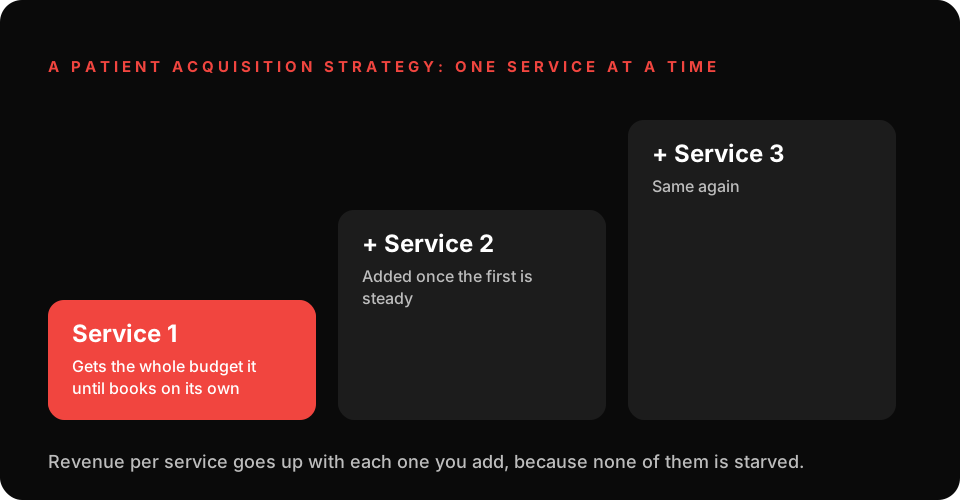
Every client we’ve grown did it this way, and their revenue per service went up with each one we added. Spread a budget across twelve services and none of them ever gets enough to learn who books.
8 ways to increase patient acquisition
- Market the condition, not the specialty. People search for what’s wrong with them, not for the doctor who fixes it.
- Start with one service and one page. Get it booking before you spread the budget.
- Get onto the shortlist. A complete Maps listing, reviews coming in every month, and answers that AI can pick up.
- Win the comparison. Say who the treatment is for, show a price range, and let real patients do the talking.
- Make the first contact easy on a phone. A call button on the first screen and a form with as few questions as you can get away with.
- Answer while they’re still comparing. Minutes, not the next morning.
- Follow up based on why they came. Someone in pain needs a different conversation from someone thinking about a cosmetic procedure.
- Keep your referrers in the loop. A doctor who hears back about their patient sends the next one.
Most practices are already doing one or two of these. The ones that pull ahead do all eight, and keep doing them.
What a new patient should cost
It depends on what you treat and where. On Google, a booking or a call usually lands somewhere between $10 and $50 in healthcare, and the PPC for healthcare budget we start one service with is around $1,200 a month. For a weight loss clinic, where people don’t search for the surgery, social ads got us down to $11 per lead. Which platform makes sense for your practice is the whole question behind healthcare lead generation.
Whatever the channel, the number worth watching is what you paid for each patient who went ahead with treatment. And once they’re in, patient engagement strategies are what turn that first visit into the fifth.
Find out where new patients pass you by.
Six questions, then learn about the marketing opportunities in your area, including how you compare on the shortlist.
Get your assessment →