Healthcare Marketing Campaigns: 4 That Worked and Why
A bus, some search ads, an email and an Instagram campaign. Four campaigns we ran for real clients, what was wrong before, and why each one worked.
The healthcare marketing campaigns that worked best for us looked nothing alike. One was a bus parked outside a practice. One was a set of search ads, one was an email, and one ran on Instagram. What they shared was the thinking behind them, and that’s the part worth copying, so here are four healthcare marketing campaigns that booked real patients, told the way they happened.
We don’t name clients, so each one is described by what it does. And where we have a real number, you’ll get it. Where we don’t, I’ll say so instead of rounding one up.
The sampling bus: ten minutes that people remembered
A colorectal practice we work with also offered treatments on devices from a body contouring maker: pelvic floor, body sculpting and face toning. The maker had a tour bus, so we brought the bus to the practice.
The problem with device treatments is that they’re hard to explain. You can describe pelvic floor therapy on a page all day and people still have no idea what it feels like, so they don’t book it.
Instead of giving away a full free session, people got a 10 minute mini session. Ten minutes isn’t enough to see a change in the mirror, and we never pretended it was. But people felt it. They walked off the bus feeling a little toned, a little tighter, and they told their friends about it.
Word of mouth did the rest. There were several providers nearby offering similar treatments, and people still picked this practice, because it was where they first heard of the treatment and where they first felt it.
So the lesson: a taste beats a full free session. Whoever gives someone their first experience of a treatment is the one they remember when they’re ready to pay for it. It’s one of the healthcare branding strategies that work off the screen.
Search ads for hemorrhoids, not proctology
A colorectal practice was built around hemorrhoid surgery and the aftercare that goes with it. Every one of its patients came through other doctors, and none came from digital. That works until you want more patients, because patient acquisition through referrals stops at whatever your network sends you.
It did have SEO. The trouble was that it targeted “proctology”, a word very few people ever type. Somebody with a problem searches for the problem.
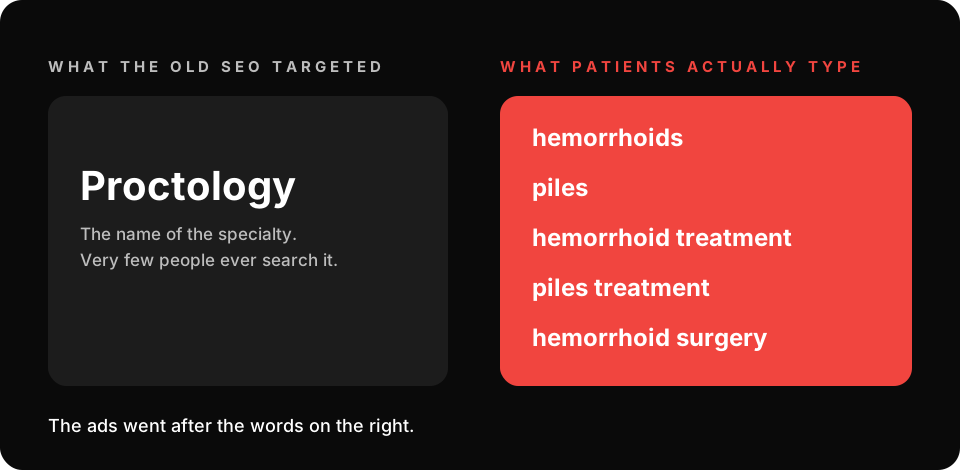
So we ran Google Search Ads on hemorrhoid and piles searches, and set them up to chase booked appointments and phone calls, which is what PPC for healthcare that pays for visits means in practice. Slowly but surely the conversions climbed, week after week, into a volume the practice had never seen from the internet. There’s no figure for this one, so we won’t make one up.
The lesson: PPC for healthcare aimed at the condition finds people the specialty name never will. Advertise what patients search for.
Not sure which words your patients actually type into Google?
Let us find their words for you →A fiber brand: email first, then Amazon
This one isn’t a practice, but the lesson carries straight over. A fiber supplement brand sold its product on Amazon, and it had a base of past customers that nobody was talking to anymore.
The obvious move was paid social. Find new buyers on Facebook, Instagram and TikTok. We didn’t start there. Instead of paying for strangers, we started with an email campaign that revived the old customer base, people who already knew the product and had bought it before. An email like that has to follow the FTC’s CAN-SPAM rules, including a clear way to opt out that you honour quickly.
Then we ran ads on Amazon itself, because that’s where the product is bought. Nobody scrolling Instagram is in the middle of buying fiber. Somebody on Amazon might be. Between the two, we moved the brand into profit.
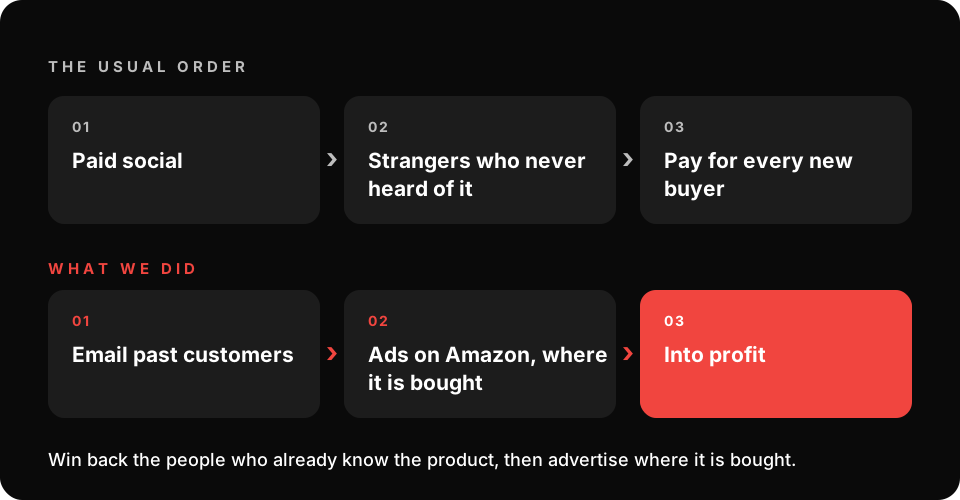
The lesson: win back and keep the customers you already have before you pay for new ones, and advertise where the thing is bought. For a practice, the old customer base is every patient who hasn’t been back in a while, and patient engagement strategies for lapsed patients are the cheapest marketing you’ll ever run.
Old patient list sitting there, and no idea what to send them?
Let us write the win back for you →Weight loss surgery, marketed on Facebook and Instagram
A weight loss surgery clinic wanted more surgical patients. The catch: very few people search for “bariatric surgery” or the names of the procedures. Run search ads on those words and you’re fighting over a tiny pool.
But when we did the research, a lot of people in the area were clearly concerned about obesity and their weight. The need was there. They just weren’t searching for the surgery yet.
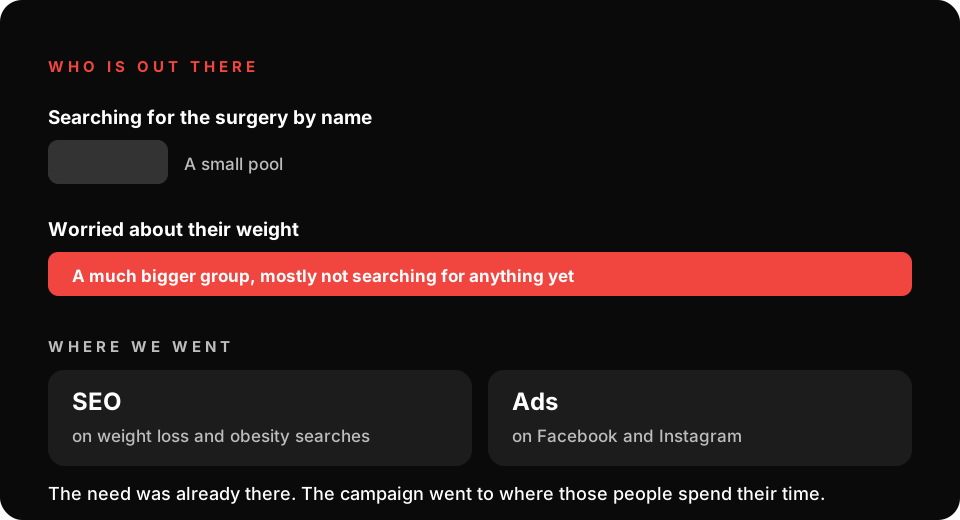
So the SEO went after weight loss and obesity searches, through healthcare branding around the problem people search, and the ads ran on Facebook and Instagram, where those people spend their time. That choice of platform is what healthcare lead generation on Facebook and Instagram is for.
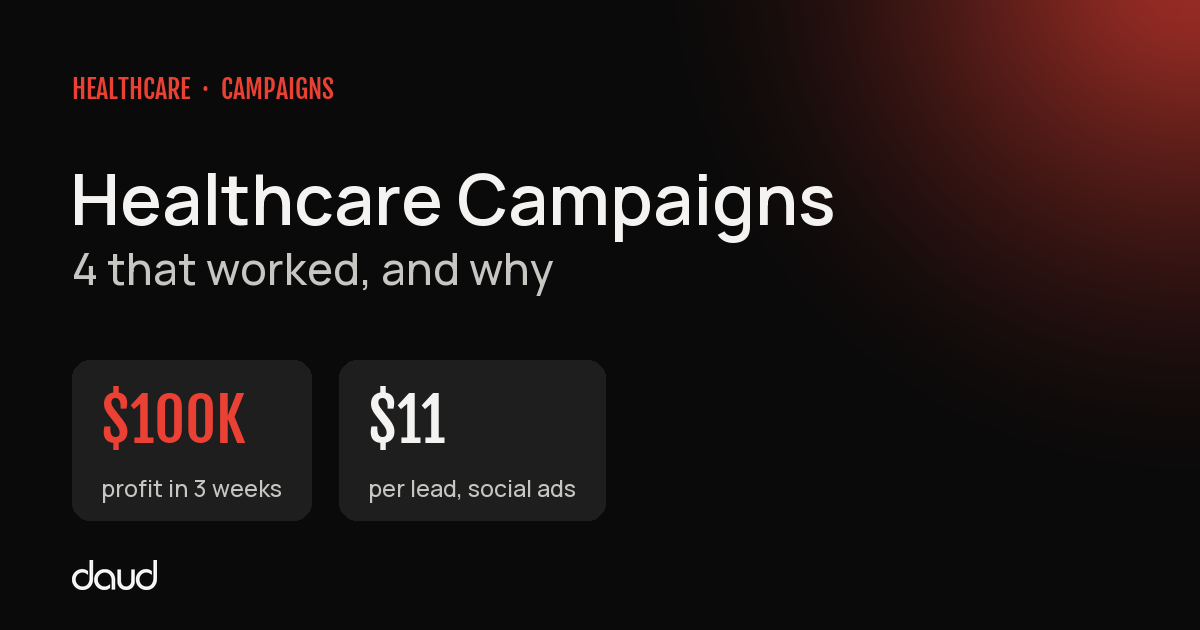
The result was $100K in profit in 3 weeks, from 19 patients. Then a second weight loss clinic used the same approach and got $11 per lead on social ads.
The lesson: when a treatment has low search volume, market the problem, and do it where people already spend their time.
Hardly anyone searches for your procedure by name?
Let us find your hidden demand →The pattern behind these healthcare marketing campaigns
A bus, Google, email plus Amazon, and Instagram. Each one picked one problem and went to the one place those people already were.
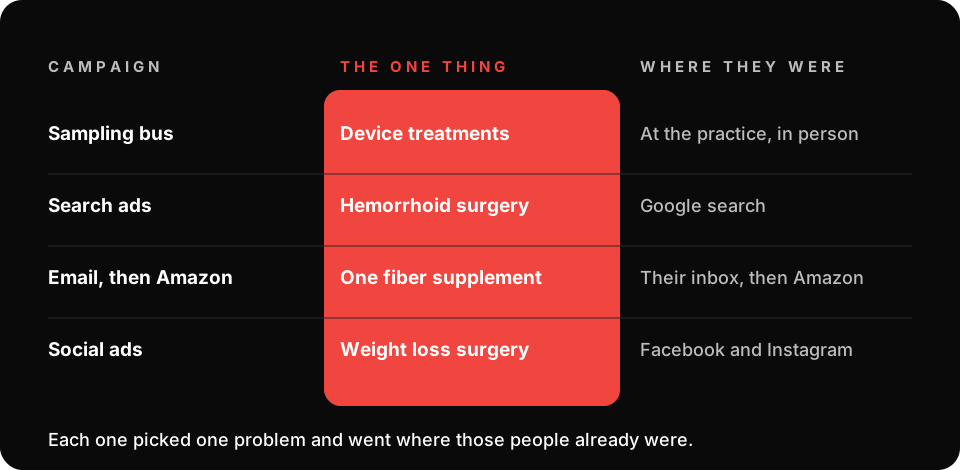
We understood one thing early on: a practice that markets everything at once teaches nobody anything. So we market one service until it books reliably, then add the next, and the revenue per service goes up with each one we add. The catch is picking the right one. Put the wrong treatment on the wrong platform and you’re hunting for a needle in a haystack. That’s the whole idea behind a healthcare marketing strategy built one service at a time.
It also keeps the cost sane. On Google, one service usually needs about $1,200 a month in ad spend, and a booking or a call tends to cost $10 to $50 depending on the area and the competition. Spread that across ten services and none of them gets enough to work, which is why a healthcare marketing budget for a single service is where we start.
4 ways to borrow from these healthcare marketing campaigns
- Let people try it for ten minutes. If you offer a device treatment, a short taster at an open day or local event will do more than a discount on a full session.
- Rewrite your ads in patients’ words. List the conditions you treat the way a patient would say them out loud, and put your search budget there.
- Email the patients you already have. Before any new ad spend, reach the people who haven’t been back. Healthcare email examples that win patients back show what to send.
- Find where the worried people are. If nobody searches your procedure, look for the problem behind it and go to the platform where those people spend their time.
None of these need a big budget. They need one service, a clear idea of who it’s for, and the patience to let it work before adding another. And once patients do come in, why patients go ahead after a consultation decides how many of them book the treatment.
Find the campaign your practice is missing.
Six questions, then see which service to market first and where its patients actually spend their time.
Get your assessment →