3 Google Ads for Doctors That Win Their Market
Three ads we wrote to show what works: one for a condition, one for an urgent problem, one for an elective consult. The words, the keywords, the page and why each one wins.
Most Google Ads for doctors read like the sign outside the building: the practice name, the specialty, a phone number. That tells a patient who you are, but it doesn’t answer what they just searched. The ads that win a market do, and that’s the whole idea behind Google Ads for doctors that book the visit.
So below are three ads we wrote as illustrations for this post. They didn’t run for a client and there are no results attached to them. They show how we’d build an ad for three very different situations, and for each one you’ll see the ad, the keywords, the page it lands on and why it beats the ads around it.
The rules every ad has to fit
A responsive search ad gives you up to 15 headlines of 30 characters and up to 4 descriptions of 90 characters, plus two 15 character paths for the web address. Google mixes and matches them, usually showing two or three headlines at once. So every headline has to make sense next to any of the others.
Healthcare adds two more limits. You can’t promise an outcome, so no “guaranteed results” or “pain free forever”. And Google’s rules on personalized ads treat health as a sensitive category, so you can’t build audiences around a condition. The search itself has to do the targeting, which is why the keywords matter as much as the words in the ad.
3 Google Ads for doctors that win their market
- The condition ad. A problem patients search, in their own words.
- The call first ad. An urgent problem, answered by phone during opening hours.
- The consult ad. An elective consult with a price range and a preview.
The practices in these are made up, and the details are placeholders. Every claim in a real ad has to be true for your practice.
1. A search ad for a condition patients search
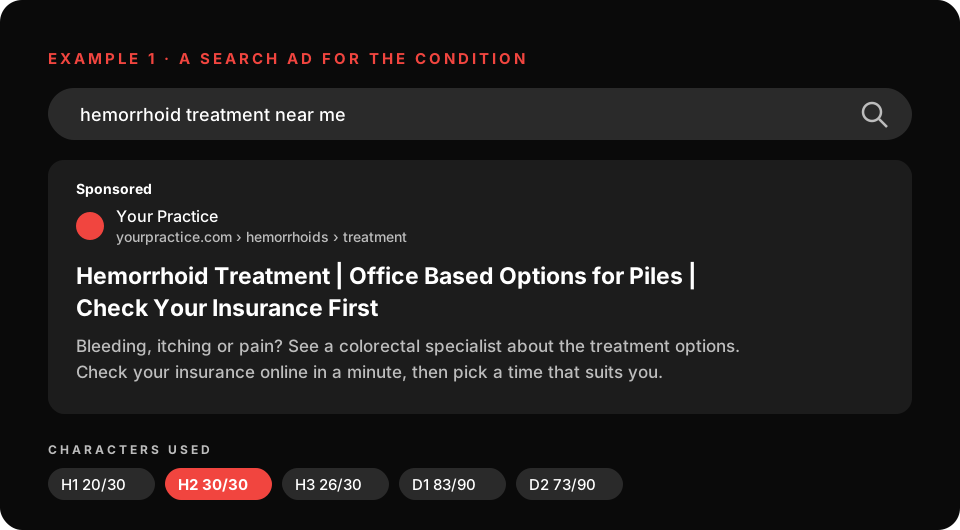
Keywords: hemorrhoid treatment, piles treatment, hemorrhoid doctor near me, bleeding hemorrhoids, hemorrhoid removal. Phrase and exact match, with “cream”, “home remedy” and “pictures” added as negatives so we don’t pay for people who only want to read about it.
No idea which searches to block before they cost you?
Let us build your keyword list →Lands on: a page about hemorrhoid treatment and nothing else. It lists the options the practice offers, says who each one is for, and has a call button on the first screen. A link to insurance verification before they book backs up the second description.
Why it wins: a lot of practices advertise the specialty, and almost nobody searches for that. This ad repeats the patient’s own words back to them, and the page keeps saying the same thing after the click. That match is what gets the call, and the thinking behind it is PPC for healthcare built on the condition.
2. A call first ad for urgent problems
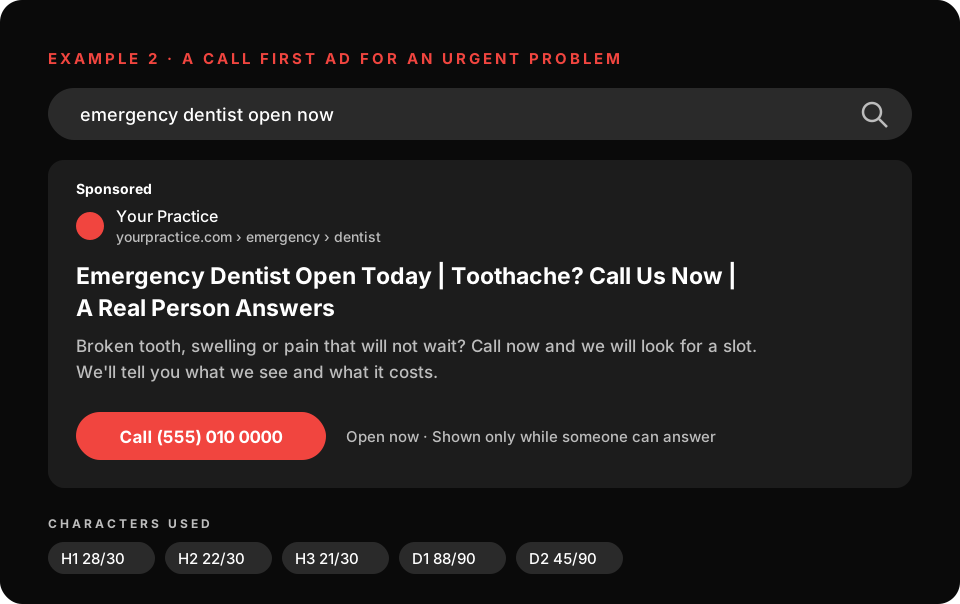
Keywords: emergency dentist, emergency dentist near me, dentist open today, broken tooth, toothache dentist. These are people in pain, on a phone, who want to talk to someone now.
Lands on: the phone first. The ad carries a call asset scheduled to show only while the front desk is open, and the whole campaign runs on an ad schedule that matches the same hours. Anyone who taps through instead lands on an emergency page with the number at the top and a short list of what counts as urgent.
Not sure how to show the call button only when you’re open?
Let us set up your call hours →Why it wins: a call button that shows at 11pm and rings out is money spent on a patient you never speak to. This one only asks for a call when a person will pick up, and “a real person answers” is the headline nobody else writes. Urgent pain is also the reason patients act fastest, which is why this kind of ad suits patient acquisition when the problem won’t wait.
3. A consult ad for an elective procedure
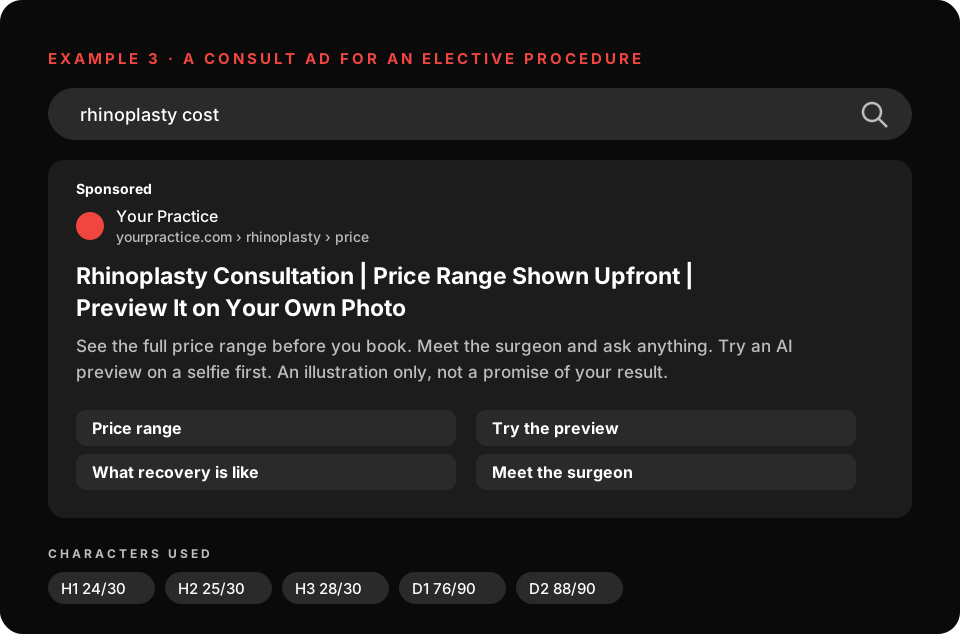
Keywords: rhinoplasty cost, rhinoplasty consultation, nose job price, rhinoplasty surgeon near me. Searches with a price word in them are the ones we bid hardest on, because that person has moved past wondering and is comparing.
Lands on: a rhinoplasty page with the price range near the top, what recovery is like, and a link to an AI try-on for a nose or face procedure, so they can see an illustration on their own photo before they book. The sitelinks go straight to each of those parts.
Why it wins: cosmetic patients often compare for a while, and price is the question a lot of practices dodge. Showing it filters out people who were never going to book and pulls in the ones who can. The try-on gives them a reason to stay on your page instead of going back to the results. And the second description says plainly that it’s an illustration and not a promise, which keeps it inside Google’s rules.
Making them yours
None of these should be copied word for word. The keywords change with your area and the way people there talk, and the headlines change with what you actually offer. We write more headlines than Google needs, let it test them, and keep the ones that bring bookings rather than clicks.
Not sure what your own headlines should say?
Let us write your ads for you →Notice what the three have in common, too. Each one is built for a single service, so the budget isn’t split between a dozen ads that each get a few clicks a week. On about $1,200 a month for one service, a booking or a call usually costs somewhere between $10 and $50, and that only holds when every dollar goes to one clear search. A practice that offers all three of these would run them one at a time, starting with whichever has the best margin or the most people searching, and add the next once the first books on its own.
And a great ad can still lose if the setup around it is wrong. If yours are running and nobody calls, it’s worth going through why Google Ads don’t work when the setup is off before rewriting a single word.
See what your ad should say.
Six questions, then learn about the marketing opportunities in your area, including what patients near you actually search.
Get your assessment →