PPC for Healthcare: Google Ads That Book Patients
What Google Ads costs a practice, the budget we start with, and what decides whether you get patients or just clicks.
When something’s wrong, people don’t wait around. They pull out their phone and search for it. PPC for healthcare puts your practice right at the top of that search, above every clinic that’s still waiting on its website to rank. You only pay when someone clicks, and if it’s set up right, a good chunk of those clicks turn into calls and booked appointments.
If it’s set up wrong, it’s the quickest way to burn through a marketing budget. So here’s what Google Ads actually costs a practice, the budget we’d start with, and the few things that decide whether you get patients or just clicks.
What is PPC for healthcare?
PPC means pay per click. You bid to show up at the top of Google for searches like “hemorrhoid treatment near me”, and you pay each time someone clicks your ad. You’ll hear it called Google Ads for doctors, paid search for physicians or medical PPC. Same thing.
What makes it different from most marketing is timing. The person searching needs help today. They didn’t scroll past your ad, they asked Google a question and your ad showed up as the answer.
How much do Google Ads cost for a medical practice?
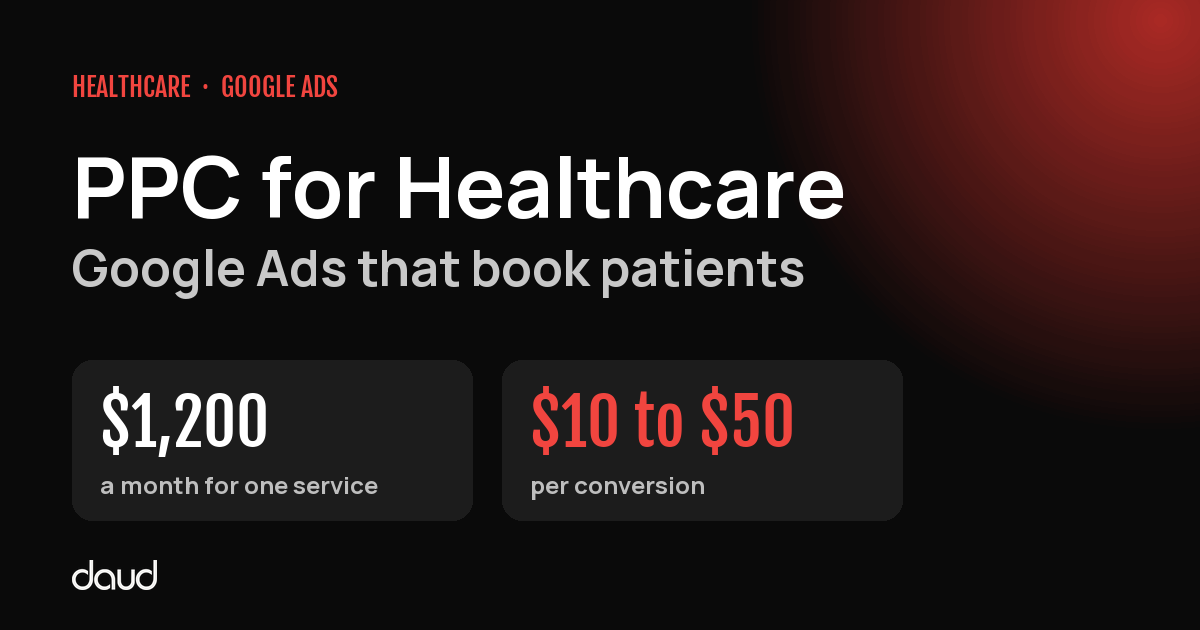
For one service, a budget of around $1,200 a month is usually enough. That’s what you pay Google, and it’s separate from whoever manages it for you. It’s enough to figure out what works in your area without putting the whole practice on the line in month one.
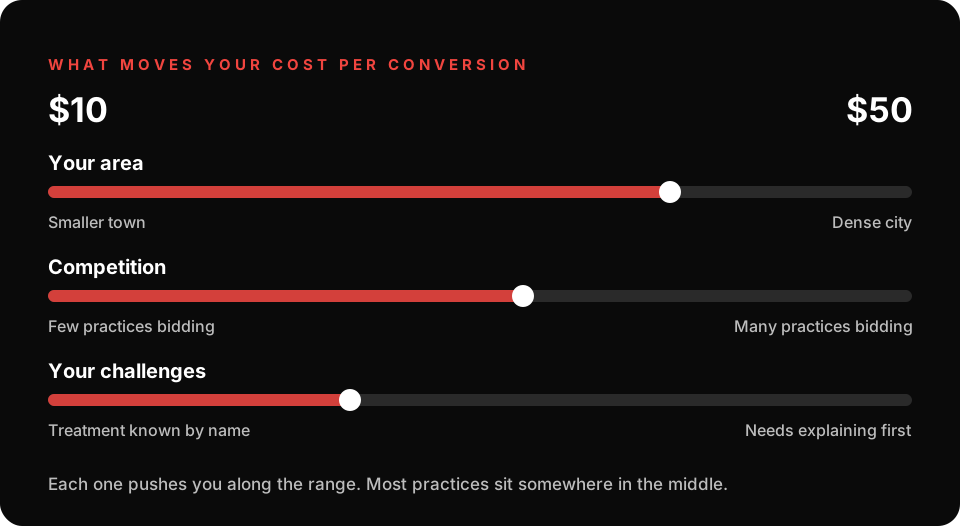
The number we actually watch is cost per conversion, meaning what you pay on average for one booked appointment or one call. In healthcare that usually lands somewhere between $10 and $50. Where you land depends on your area, how many other practices are bidding on the same searches, and how much explaining your treatment needs before someone’s ready to book.
We go after the lowest cost per confirmed visit in your market. Clicks don’t pay your rent, patients do, so that’s the number worth comparing anyone on.
Why we start Google Ads for doctors with one service
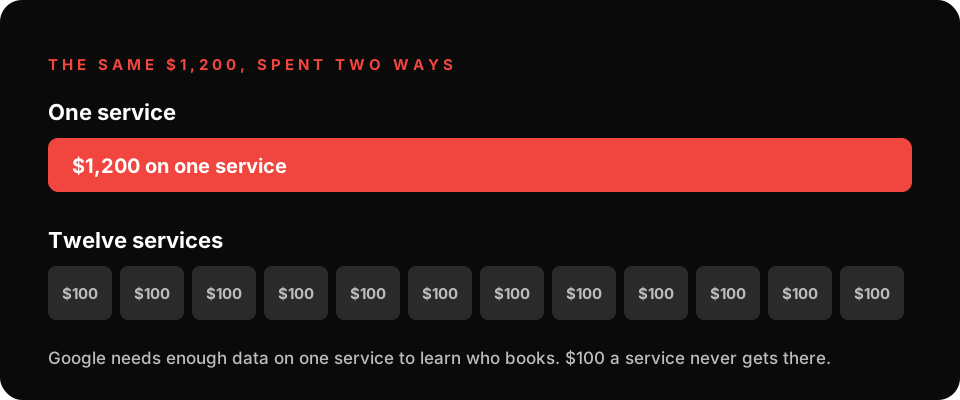
Most practices want to advertise everything they offer. Twelve services on a $1,200 budget is a hundred dollars each. That’s nowhere near enough for Google to figure out who books and who doesn’t, so none of them ever get good.
So we do the opposite. We pick one service first, usually the one with the best margin or the most demand, and market that until it books reliably. Then we move to the next one. Every client we’ve grown did it this way, one service at a time, and their revenue per service went up with each one we added.
Starting with one is the ideal. But it has to be the right one. Pick the wrong procedure and you’re looking for a needle in a haystack: the budget goes, the bookings don’t, and it looks like Google Ads don’t work. That’s why we test two or three services in the first week and back the one that books. If you’d rather choose it yourself, go ahead. Look for the treatment people actually search for, with a good margin and room in your diary for more of it.
Not sure which procedure that is?
Let us find the right one →Paying for visits, not clicks
Most reports you’ll get stop at the click. Clicks are easy to buy and they tell you nothing about whether anyone actually showed up.
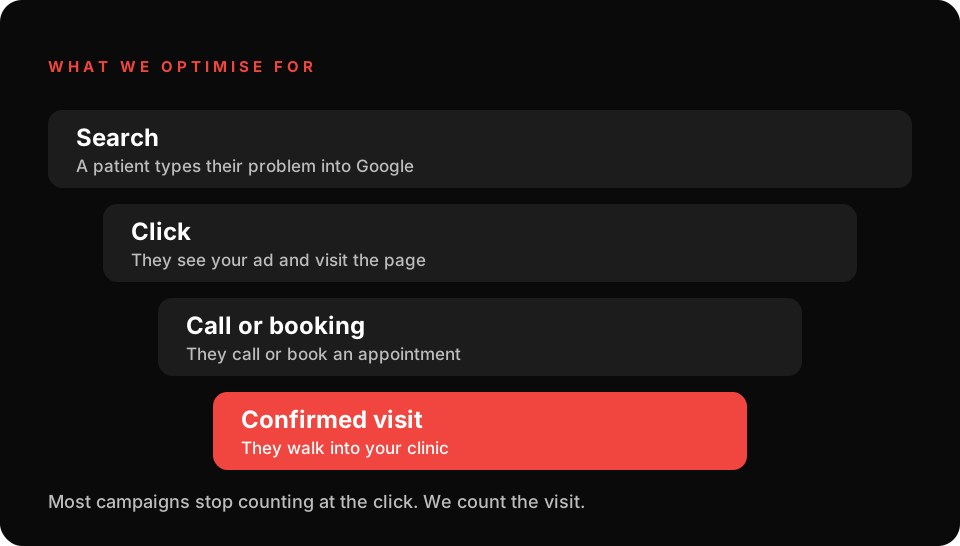
We optimise for booked appointments and calls, then check them against the visits that actually happened. Once Google knows which clicks turned into patients, it goes and finds more people like them. That’s how our clinics end up with more qualified, confirmed visits while paying less than the industry usually does.
Advertise the condition, not the specialty
People search for their problem. They don’t search for the specialist who fixes it.
We had a colorectal practice where hemorrhoid surgery and its aftercare was the main thing, even though the surgeon does a lot more than that. A lot of people have hemorrhoids, so it made sense. They were getting patients from their referral network but nothing from their digital presence. The SEO they had was built around proctology keywords, and barely anyone searches that. So we ran a Google Ad for hemorrhoid treatment, which they already offered in a bunch of ways, and aimed it at what people were actually typing: hemorrhoids and piles. We optimised for booked appointments and calls. Slowly but surely the conversions started coming in, from a channel that had brought them nobody before.
Bariatrics was the opposite problem. Very few people search for bariatric surgery, and even fewer search for the actual procedures. It isn’t even its own specialty; any general surgeon can do it with the right training. So the whole hemorrhoid playbook went out the window. But when we checked how many people in the area were dealing with obesity and weight loss concerns, the need was obviously there. People just weren’t searching for the surgery.
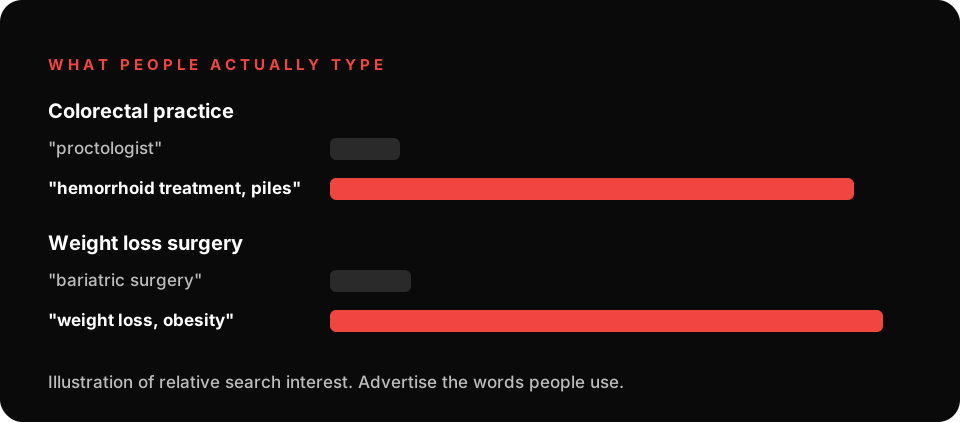
So for SEO we went after weight loss and obesity. For ads, we skipped Google and went to Facebook and Instagram, where we could reach people who were weighing their options without ever typing it into a search bar. That clinic made $100K in profit in three weeks, from 19 patients. We did the same for another weight loss clinic and got it down to $11 per lead, which is lower than the lowest numbers you usually see in this industry.
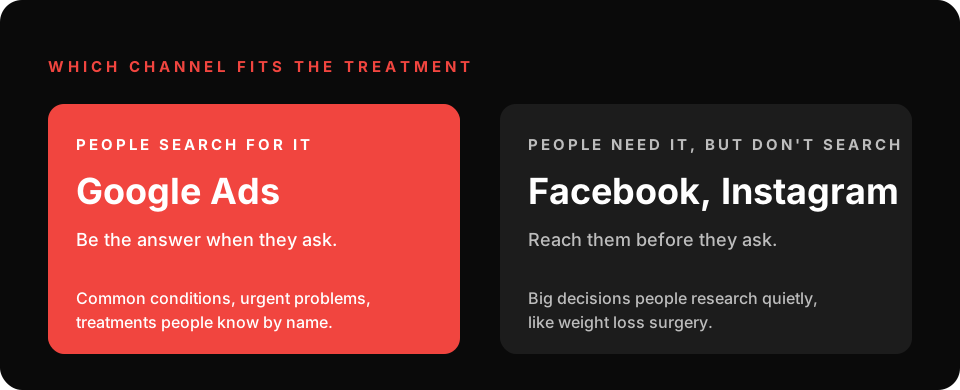
So before spending anything on Google Ads, the first question is whether people search for what you do. If they do, catch them on Google. If they don’t, go find them where they already are. That call, made from your specialty and your location, is the heart of healthcare lead generation. And when people do search and the phone still stays quiet, the setup is usually the problem, which is why Google Ads don’t work even when people search.
Google Ads or SEO first?
Ads start bringing calls in the first week, because the demand is already there and you’re just catching it. SEO and Google Maps take 4 to 6 months to rank in a mildly competitive market. They’re worth doing, they just can’t be sped up by throwing money at them.
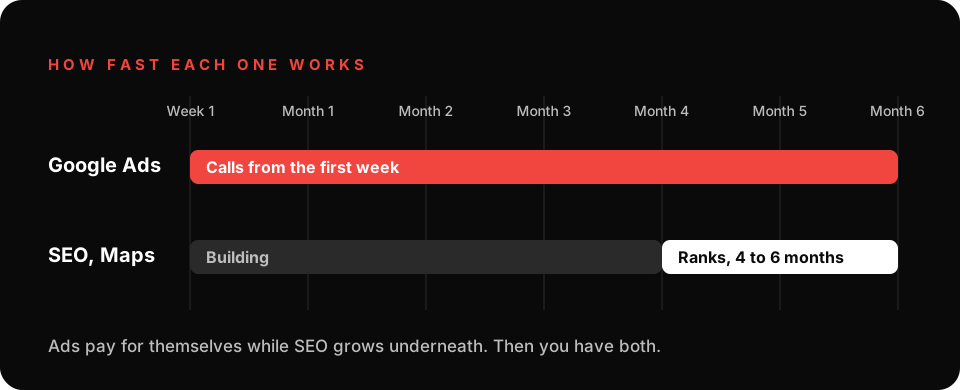
So we run the ads first and build the healthcare SEO underneath while the ads pay for it. By the time the SEO kicks in, you’ve got both.
Keeping PPC for healthcare HIPAA safe
The ads themselves aren’t the HIPAA problem, the tracking is. A normal ad pixel on a booking confirmation or intake form can send patient information straight to the ad platform, and the HHS guidance on online tracking technologies is pretty clear that it shouldn’t. The fix is simple enough. The ad platform only ever hears that a booking happened, never who booked or what for, and that’s still enough for it to optimise. It’s why every campaign we run sits on HIPAA compliant tracking from day one.
6 PPC tips for healthcare practices
- Send clicks to a page built for that one service. Not your homepage.
- Make the ad and the page say the same thing. If the ad says hemorrhoid treatment, the page it lands on should too. People leave the second it doesn’t match. Three Google Ads for doctors written out in full show what that looks like.
- Put a price range on that page. It filters out people who were never going to book.
- Track phone calls, not just forms. A lot of patients would rather just call.
- Only run ads when someone can pick up the phone. A missed call is a paid click wasted.
- Go through the search terms every week. You’ll always find searches you never meant to pay for.
None of this is a secret. The hard part is doing all of it at once, every week, with every other practice in your area bidding on the same patients.
See what Google Ads would cost your practice.
Six questions, then learn about the marketing opportunities in your area, including which service we’d start with.
Get your assessment →