Why Google Ads Don’t Work for Some Doctors
Most practices that quit Google Ads had something broken in the setup. A few really are a bad fit. Here’s how to tell which one you are.
A lot of doctors come to us after a few months of Google Ads with the same story. They spent the money, the clicks came in, and the phone stayed quiet. So they decide it doesn’t work. Sometimes they’re right, and knowing why Google Ads don’t work for a given practice is how you tell a bad fit from a bad setup.
Those two need very different answers. A bad setup can usually be fixed on the same budget. A bad fit means the money should go somewhere else, and no amount of tweaking bids will change that.
A bad fit or a bad setup
Google Ads only does one thing. It puts you in front of people at the moment they search. If people search for what you treat, that’s about the best place a practice can be. If they don’t, you’re paying to stand in an empty room.
In our experience, most accounts we open fall in the first group. People are searching, the ads are showing, and something between the click and the visit is broken. The practices in the second group are fewer, but they lose the most, because they keep raising the budget on a channel that was never going to work for them.
Where your account breaks
Think of it as a chain. Someone searches, sees the ad, clicks, lands on a page, calls or books, and then turns up. Every account that “didn’t work” broke at one link in that chain, and each break leaves its own mark in the numbers.
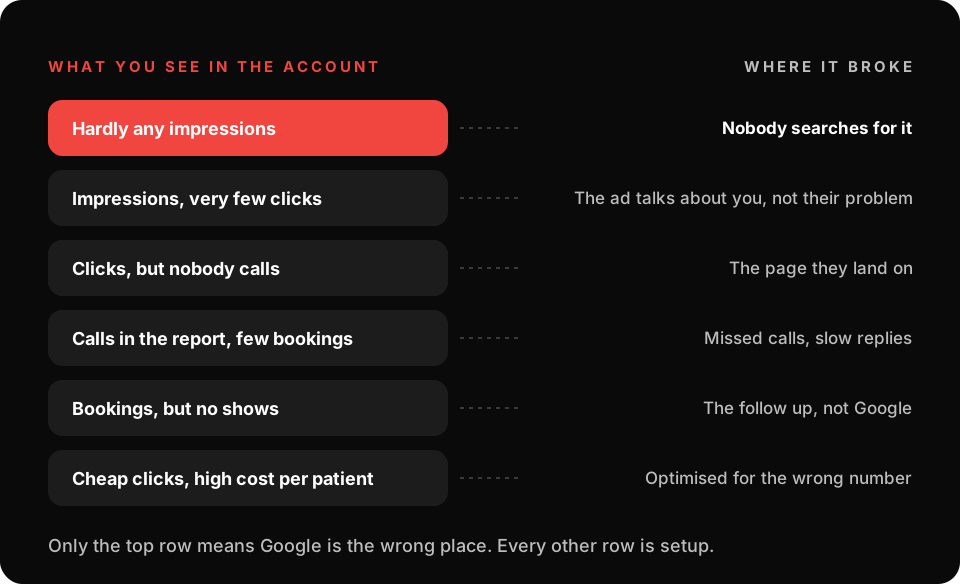
So before anyone talks about spend, find the row that looks like your account. Very often it’s two of them at once, and the fix for each is different.
7 reasons why Google Ads don’t work for doctors
- Nobody searches for the treatment. Then there’s nothing to catch, so go where people already spend time, the way we did for a weight loss clinic with healthcare marketing campaigns built on hidden demand.
- The ads sell the specialty. Run PPC for healthcare on the condition in the words patients use, like piles rather than proctology.
- Clicks land on the homepage. Give the service its own page that says what the ad said, one of the PPC for healthcare tips most practices skip.
- Nobody answers the phone. Show the ads and the call button only while someone can pick up.
- It’s set up to get clicks. Tell Google which clicks booked, so it goes and finds more people like them. That’s PPC for healthcare that pays for visits.
- The budget is spread across every service. Market one service until it books reliably, then add the next, with a healthcare marketing budget sized for that one service.
- Health targeting is off the table. Google’s personalized advertising policy treats health as a sensitive category, so you can’t build your own audiences around it the way a shoe shop retargets its visitors. Let the search do the targeting instead: the keyword is the audience.
Only the first and the last are limits of Google itself. The other five are setup, and every one of them costs less to fix than quitting the channel and starting again somewhere else.
Five fixes is a lot to take on next to running a practice.
Let us fix the setup for you →Four tests to run before you switch it off
You don’t need an agency to find most of these. You need about an hour and a phone.
Start with the search terms report. It shows what people actually typed before they clicked, which is often very different from the keywords you chose. Read it line by line for the last month. Every search you’d never want a patient from is money you can stop spending tomorrow.
Hundreds of search terms and no idea which ones to cut?
Let us read your search terms →Then search for your own treatment on your phone, the way a patient would, and click through. Does the page you land on use the same words as the ad, and can you call from the first screen without scrolling? After that, ring the number in the ad at 6pm on a weekday and again on Saturday morning, and see who answers.
Last, open the conversion settings and check what Google is counting. If it’s counting page views or taps on the phone number, it’s learning to find people who click rather than people who book. Healthcare marketing analytics that follow a click to a booking fix that at the source.
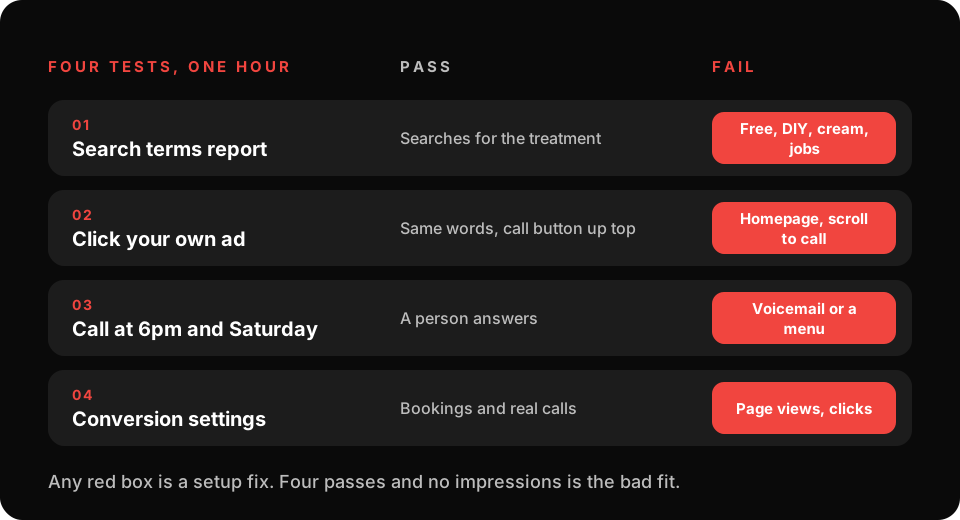
If all four pass and the account still has hardly any impressions, that’s the bad fit. Picking a different channel for your specialty and location is the job of healthcare lead generation that starts with where patients are.
Should healthcare businesses use PPC?
Yes, when people search for what you treat. In that case nothing else is as quick. Ads usually bring enquiries in the first week, while healthcare branding in organic search takes 4 to 6 months to rank in a mildly competitive market. We start one service on about $1,200 a month, and a booking or a call usually costs somewhere between $10 and $50.
But the practice has to be ready to catch what the ads send. Here’s the difference between a practice that should start now and one that should fix a few things first.
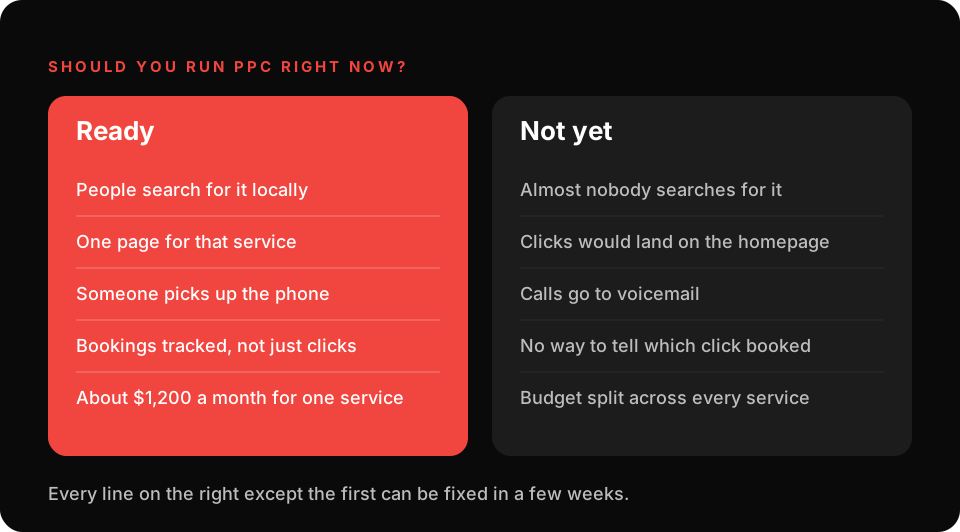
If you’re mostly on the left, Google Ads is the right call and the sooner the better. If you’re on the right only because of the page or the phone, fix those first. They’ll pay off on every channel you ever run.
Not sure which column your practice falls in?
Let us run the four tests for you →And if the ads look fine on paper but nobody clicks, look at the words. A few Google Ads for doctors written around one condition show how far most practice ads drift from what patients typed. If people book but don’t go ahead, the problem sits after the click, in patient acquisition past the first visit, and no ad can fix it.
Find out if Google Ads fits your practice.
Six questions, then learn about the marketing opportunities in your area, including whether people there search for what you treat.
Get your assessment →