Healthcare Content Marketing, with Examples
Most practice content gets written, posted and never read. Here are seven formats that patients actually use to decide, with a sample of each.
Most practices have a blog, and most of those blogs are full of holiday hours, a new hire and a post about drinking more water. Nobody searches for any of it. Healthcare content marketing built for search and AI is the writing a patient reads right before they pick a practice, and that’s a much smaller, much more specific list.
So instead of telling you what to write about, we’ve written a sample of each format below. They’re our own illustrations, not a real practice, so swap in your treatment, your numbers and your doctor.
What healthcare content marketing is actually for
A patient with a problem has three questions, more or less in this order. What is this, can you fix it, and what’s it going to be like. Content that answers those questions in their words gets read. Content that answers questions nobody asked gets skipped, however well it’s written.
That’s the whole test we use before writing anything. If a patient wouldn’t type the question into Google, ask ChatGPT, or ask the front desk on the phone, we don’t write the piece. Google says much the same thing in its guidance on people first content, and it puts extra weight on first hand expertise when the topic is health.
Where each format does its job
Not every piece works at the same moment. Some catch the patient while they’re still worried and searching, some win them over while they compare, and some only matter once they’ve booked and are nervous about the day.
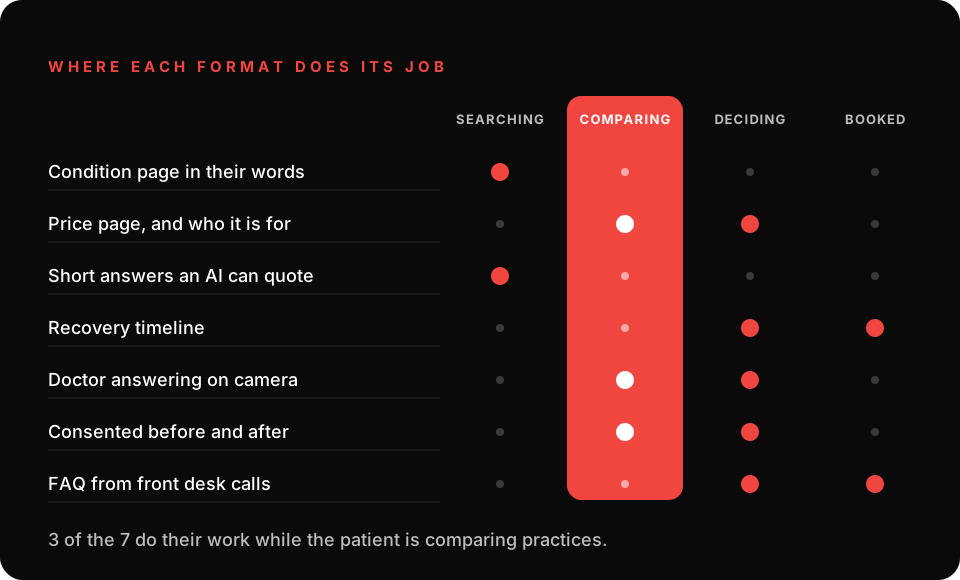
The gap we see most often is the middle. Practices write plenty of general explainers and nothing that helps someone choose, which is exactly where the price, the doctor and the real results come in.
7 healthcare content marketing examples
- A condition page in the patient’s words. Headline: “Blood on the toilet paper? What it usually means and when to get it checked.” First line: “It’s scary the first time, so here’s what we look for and which signs mean you shouldn’t wait.” Nobody searches the name of the specialty, they search what they saw.
- A price page that says who it’s for. Headline: “What a tummy tuck costs at our practice, and who it isn’t right for.” First line: “Most of our patients pay between [your low] and [your high]. Here’s what moves it up or down.” Saying who shouldn’t book is what makes the rest believable.
- Short answers an AI can quote. Question as a heading: “How long does hemorrhoid banding take?” Answer: “The banding itself takes [a few minutes] in the office, and most people are back at work [the next day].” Two plain sentences with the facts in them is the bit that gets lifted into an answer.
- A recovery timeline. Headline: “Your first two weeks after liposuction, day by day.” First line: “This is what our patients tell us at each check up, so you know what’s normal and when to call.” It takes the fear out of the part people imagine the most.
- The doctor answering the top question on camera. Title: “Does it hurt? Dr. [Name] answers in under a minute.” Opening line, spoken: “It’s the first thing everybody asks me, so here’s the honest answer.” Patients are choosing a person, and this is the cheapest way to meet one.
- Consented before and after photos. Caption: “Patient in her 40s, six months after [treatment]. Shared with her written permission.” One line under the gallery: “Results vary. Here’s what affects yours.” Real results do more than any adjective, as long as you don’t promise the same outcome.
- An FAQ built from front desk calls. Headline: “The questions our front desk answers every day.” First entry: “Can I drive myself home afterwards? No, so bring someone, and here’s why.” These are the questions people are too embarrassed to ask, or ask and then hang up.
The doctor video is the one most practices skip, and once it’s done there are plenty more healthcare video marketing ideas a clinic can shoot on a phone. The front desk FAQ almost always starts with insurance, which is a question patients can answer themselves if you let them check their insurance benefits online before they call.
Know what the page should say, but not when you’ll find the time to write it?
Let us write the first page for you →What to write first
Don’t start with one piece each about seven treatments. We pick one service, usually the one with the best margin or the most demand, and write the whole set for that service first. It has to be the right one, though. A full set of pages about a treatment nobody looks for is a needle in a haystack. The condition page, the price, the timeline, the doctor, the photos and the FAQ all point at each other and at one booking button.
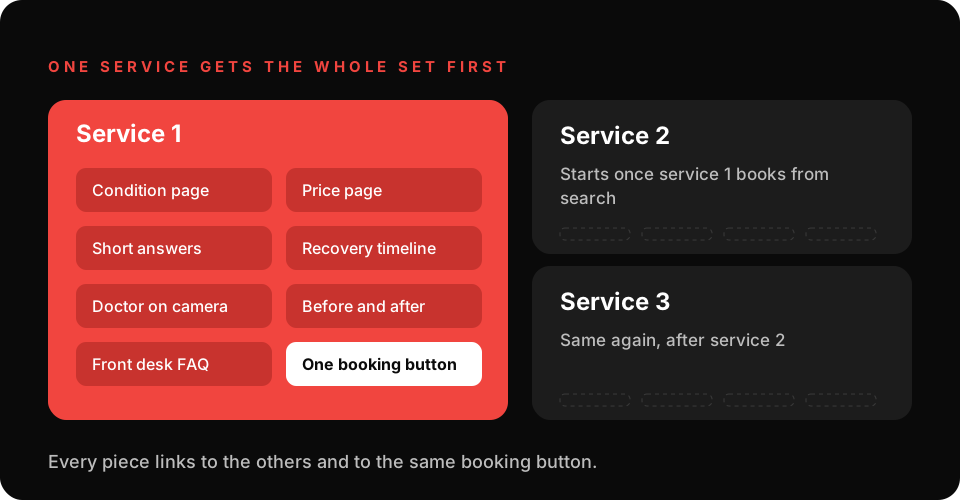
Once that service is booking from search, we move to the next. It’s the same way we run PPC for healthcare one service at a time, and it works for the same reason: a thin page about everything never gets enough attention to rank for anything.
Not sure which service should get its pages first?
Let us pick the first service for you →Turning search traffic into social media views
Now here’s the part most practices miss. Once the pages rank, SEO brings a lot of people to them, and most of those people read, leave and never think about you again. But plenty of them arrive with a question the page didn’t quite answer.
So we put a help button on the page. A visitor types their question, and leaves an email if they want the answer sent to them. Then the question becomes a short reel: the question on screen, the doctor answering it in plain words, posted to Instagram and Facebook.
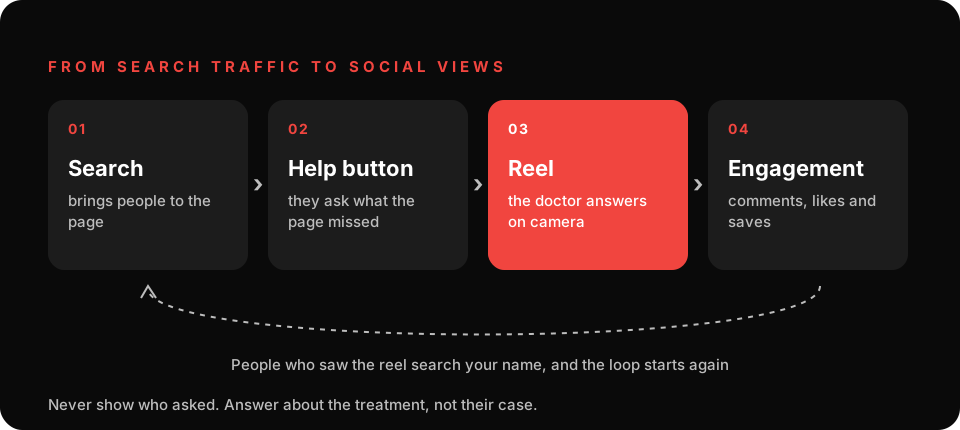
That reel tends to beat almost anything else a practice posts, because nobody had to guess what people care about. Somebody actually asked it, and a lot of other people had the same question and never asked. They’re the ones who comment, like and save it, and that engagement is what pushes it out to more people. Instead of inventing content ideas every week, your visitors hand them to you, and the doctor gets a steady list of healthcare video marketing ideas from real questions.
Keep one rule. Never show or hint at who asked, and answer about the treatment, not about the person’s own case. “Someone asked us how long recovery takes” is fine. Anything that could point back to a patient isn’t.
Want your visitors’ questions turned into reels?
Let us install it on your site →Keeping patient content HIPAA safe
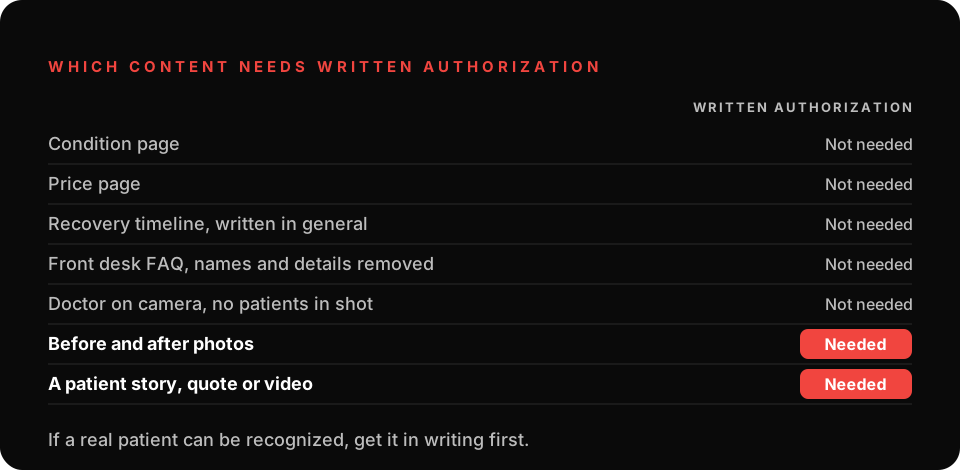
Most of these formats don’t touch a single patient’s details. A condition page, a price page or a recovery timeline is written about the treatment, not about anyone in particular. The front desk FAQ is the same once you strip out names and specifics.
Photos, stories and videos of real patients are different. Under the HIPAA rules on uses that need an authorization, a practice needs the patient’s written authorization before using their information in marketing. A nod in the consultation room isn’t enough. Get it in writing, keep it on file, and let them take it back. When you film in the clinic, anyone recognizable in the background counts too, not just the patient you meant to show.
The other place it goes wrong is the tracking on those pages, which is why we set up HIPAA compliant marketing tracking before any content goes live.
Not sure your consent forms and page tracking would hold up?
Let us handle the consent forms →How to tell if it’s working
Page views won’t tell you much. What we look at is calls and bookings that started on each page, and how many people search the practice by name, because a lot of people read an answer, close the tab and come back a week later.
Give it time, too. Content ranks on the same clock as everything else in search, which is 4 to 6 months in a mildly competitive market. Ads keep the bookings coming in the meantime, and once someone has booked, patient engagement strategies after the first booking are where the recovery timeline gets read a second time.
Find out which content your patients are missing.
Six questions, then learn about the marketing opportunities in your area, including the questions patients search that nobody nearby answers.
Get your assessment →