Healthcare Branding: SEO and AEO for Medical Practices
Your brand is whatever comes up when a patient asks Google or ChatGPT about their problem. Here’s how a practice gets its name into that answer.
Healthcare branding used to mean a logo, a color and a nice sign out front. Now it’s what comes up when someone types their problem into Google or asks ChatGPT about it, and whether your practice is in the answer. That’s the side of healthcare branding that works through SEO and AEO, and it decides who a patient trusts long before they ever call.
So this is about how a medical practice gets found in search, gets named in AI answers, and turns both into a name people already know by the time they’re ready to book.
What healthcare branding means now
Most patients don’t start with a doctor. They start with a question. Why does this hurt, is this normal, what are my options. And they ask Google or an AI before they ask anyone else.
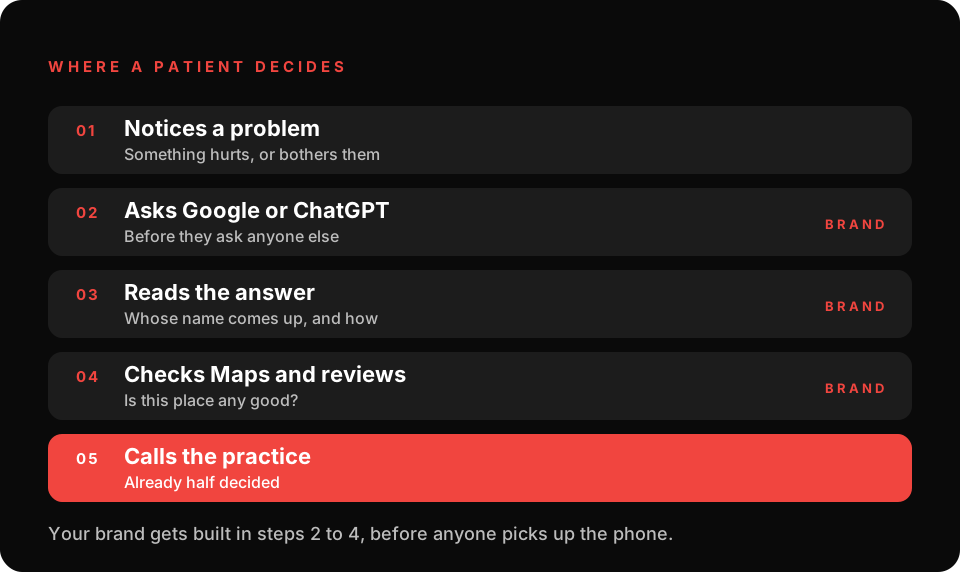
Whoever answers that question well gets remembered, which is the whole job of healthcare content marketing that answers patients. If your practice explains the problem, the options and what it costs, you’re the one living in their head rent free when they decide to do something about it. That’s the brand. The logo just helps them recognize you when they get there. That side has its own set of healthcare branding strategies outside search.
SEO for doctors: getting found on Google
SEO for doctors is mostly about being the page Google trusts for a patient’s question in your area. You’ll also hear it called medical SEO or healthcare SEO. Same thing. Three pieces do most of the work.
The first is your Google Business Profile, the listing on Maps. For anything with “near me” in it, that listing is the first thing a patient sees, so it needs the right categories, real photos, your hours, and reviews coming in steadily. A short clip of the doctor helps as well, and healthcare video marketing shot on a phone is enough for it.
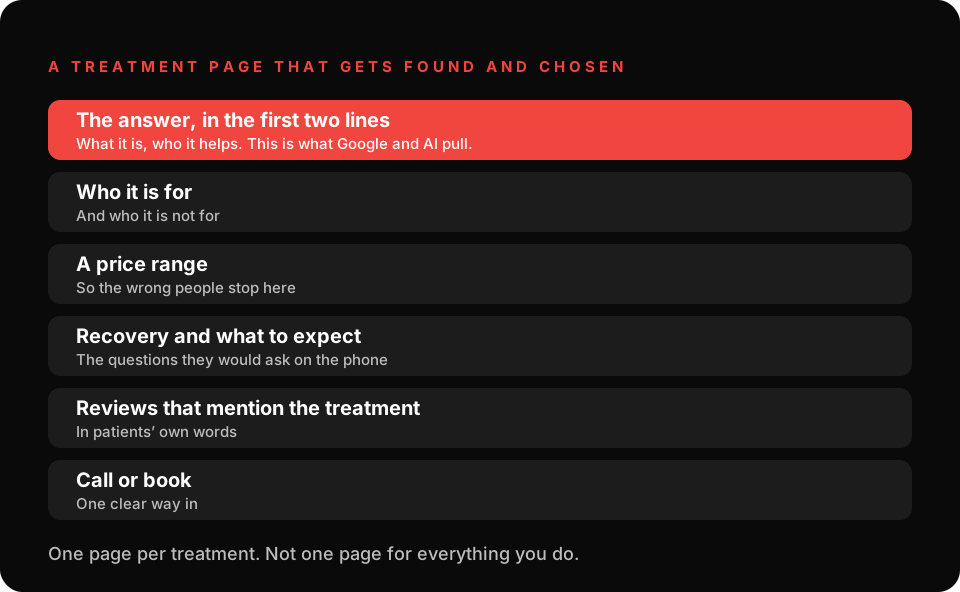
The second is a page for every treatment, written around what people actually search. We had a colorectal practice whose SEO was built around proctology. Barely anyone searches proctology. They search hemorrhoids. Once the pages talked the way patients talk, Google had something to match them to.
The third is everything that tells Google you’re real: the same name, address and phone everywhere, other local sites mentioning you, and a site that loads fast on a phone. None of it is clever. It just has to be done, and kept done.
AEO: getting your practice named in AI answers
AEO means answer engine optimization. Instead of ranking a page in a list of ten links, the goal is for ChatGPT, Perplexity or Google’s AI Overviews to mention your practice when someone asks about their problem.
There’s no secret trick to it, and anyone selling you one is guessing. Google says the same practices that work for search work for its AI features too. What changes is how much the details matter. An AI answer is pieced together from a lot of places at once, so if your website says one thing and your Maps listing says another, it gets confused and picks someone else.
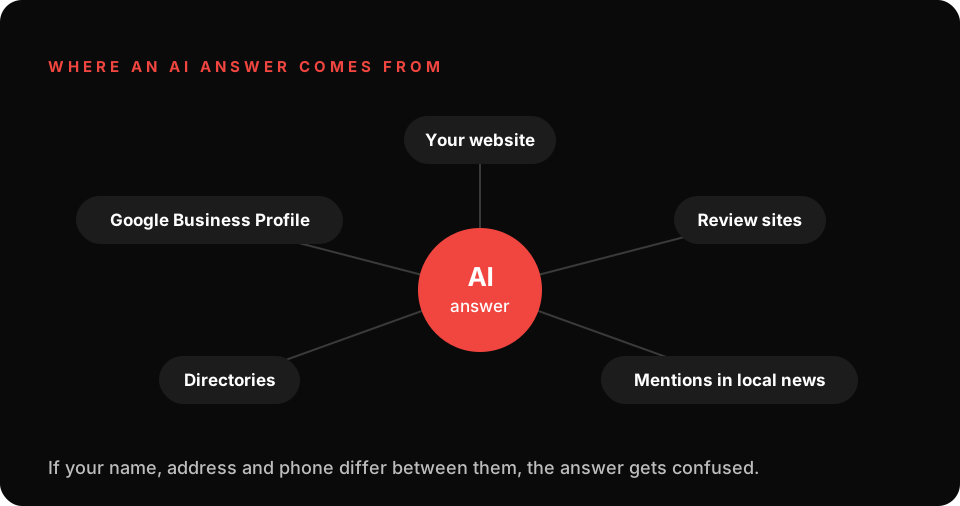
So the work is making every one of those sources say the same thing, clearly, and answering the questions patients ask in plain words near the top of the page. That’s the part an AI lifts.
SEO and AEO side by side
They’re built on the same work. The difference is what you get at the end of it.
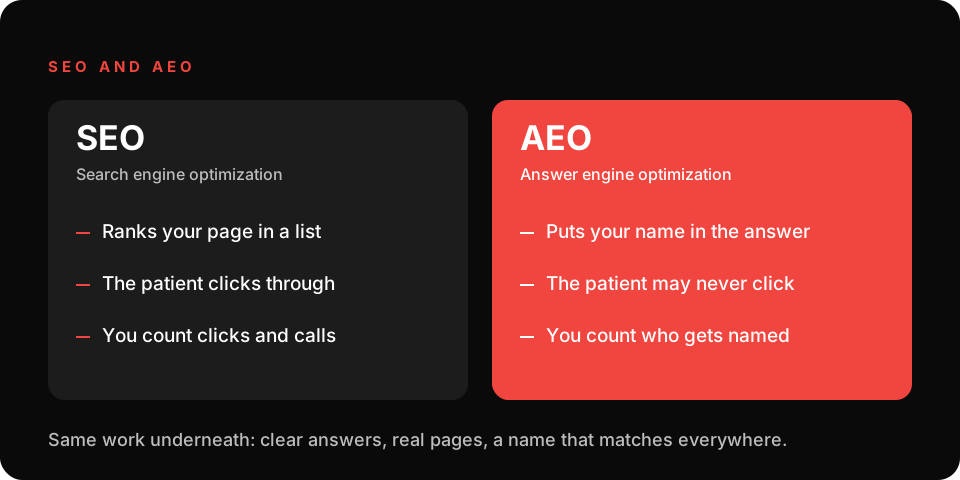
With SEO you can count the clicks and calls. With AEO a lot of people will read your name in an answer and never click anything, then search for you by name a week later. That still counts. It’s just harder to see, which is why we track branded searches alongside everything else.
7 healthcare branding strategies that work through search
- Write for the condition, not the specialty. People search what’s wrong with them, not the name of the doctor who fixes it.
- Give every treatment its own page. One page trying to cover everything ranks for nothing.
- Answer the question in the first two lines. What it is and who it helps. That’s the bit Google and AI pull into their answers.
- Put a price range on the page. It’s one of the first things patients ask, and the practice that answers it gets remembered.
- Keep your name, address and phone identical everywhere. Your site, Maps, directories, all of it.
- Ask for reviews that mention the treatment. Then reply without confirming anyone was ever a patient, because that reply is a HIPAA problem.
- Let the AI crawlers in. Check your robots.txt doesn’t block them, and mark your pages up with schema so machines know who you are and what you treat.
None of these are expensive. The hard part is doing all seven, and then keeping them up while you’re running a practice.
How long healthcare SEO takes
SEO, Google Maps and AI answers take 4 to 6 months to rank in a mildly competitive market. Nobody can speed that up with money, which is exactly why it’s worth starting now.
But you don’t have to sit and wait for it. We run healthcare lead generation that pays for the months SEO needs, on whichever platform fits your treatment, and build the brand underneath. By the time the SEO kicks in, patients already know the name.
See where your practice shows up today.
Six questions, then learn about the marketing opportunities in your area, including what patients see when they search for you.
Get your assessment →