Healthcare Branding Strategies Beyond Search
Search puts your name on the shortlist. What a patient feels on the phone, in the room and in the first ten minutes decides whether they remember it.
Search gets your name in front of a patient. Whether they remember it, trust it and pass it on gets decided somewhere else: on the phone, in the waiting room, in the first ten minutes of a treatment. The healthcare branding strategies built on search stop at the moment someone finds you, because that’s their job. This post picks up right after it.
So these are the healthcare branding strategies that have nothing to do with Google. The ones a patient feels rather than finds.
What search can’t do for a practice’s brand
Search is very good at one job. It puts you on the shortlist when someone has a problem. But a patient who finds three practices still has to pick one, and after the visit they still have to decide whether to come back and whether to mention you to anyone.
That part runs on memory. What did it feel like to call you? Did the doctor in the photos turn out to be the doctor in the room? Could they explain to their sister what you do in one sentence? None of that shows up in a ranking report, but it decides whether your name means anything the next time it comes up.
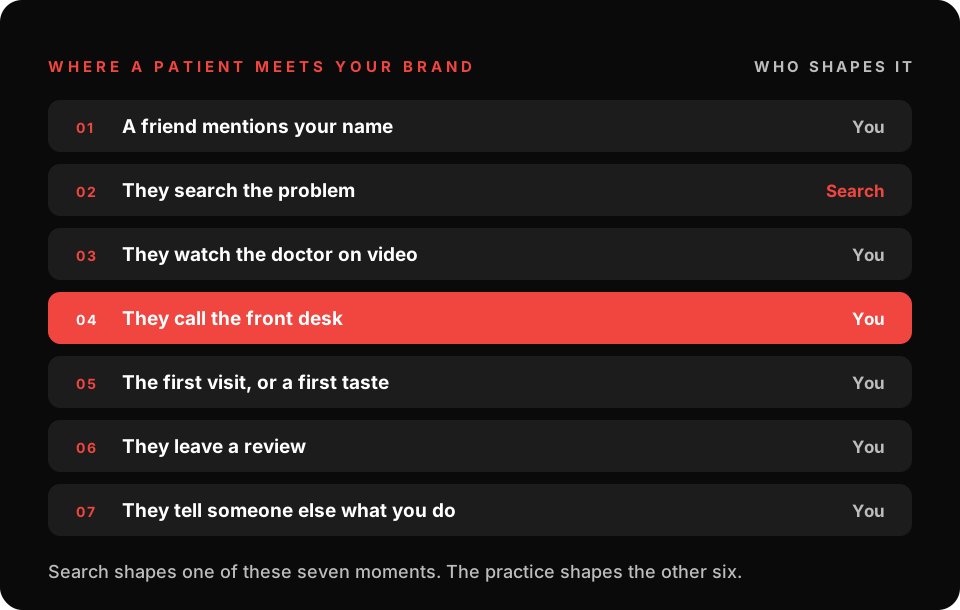
Count how many of those moments your marketing budget actually touches. For most practices it’s the search, and everything after it is left to whoever happens to be at the desk that day.
Whoever gives the first taste gets remembered
We learned this one with a colorectal practice and a sampling bus. A company that makes body contouring devices brought its tour bus to the practice, and people could walk on and get a free 10 minute mini session: pelvic floor, body sculpting or face toning. Ten minutes isn’t long enough to see any change in the mirror, and nobody pretended it was.
But people felt it. A little toned, a little tighter. And they talked about it. There were several other providers nearby offering the same kind of treatment, and people still chose this practice, because it was where they’d first heard of it and first felt it. Slowly but surely, the word of mouth did the rest.
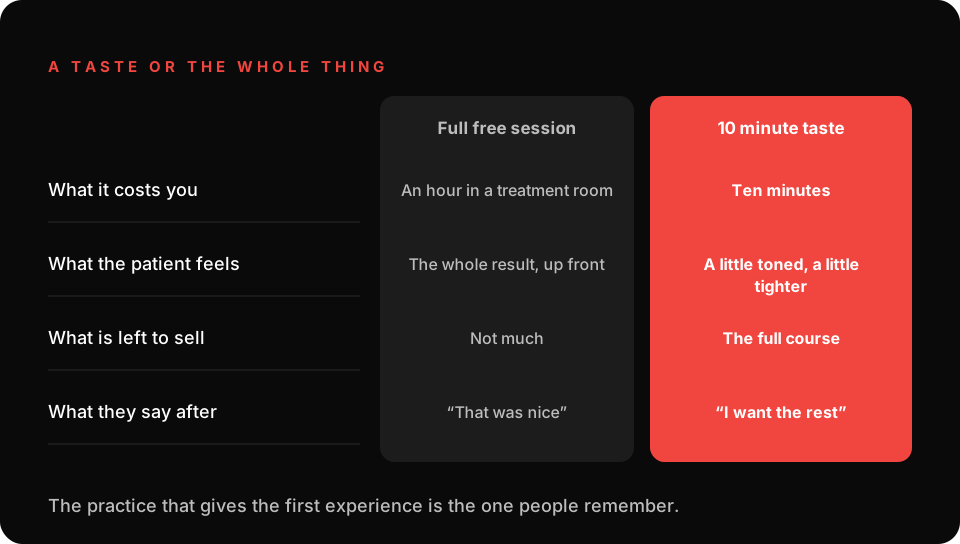
So we understood one thing. A taste works better than a full free session. The full session gives the whole treatment away, while ten minutes costs almost nothing and leaves them wanting the rest. And the practice that gives that first experience is the one people remember, even when someone else is closer.
You don’t need a tour bus for this. A few minutes of a device, a quick skin check, a short free consult with a real look at the problem. Anything a patient can feel before they’ve committed to anything.
Be known for one thing before everything
Ask a happy patient what your practice does and listen to the answer. If it’s “a bit of everything”, nobody can pass you on. People recommend a practice for one thing. Go there for your knees. Go there for veneers.
That’s why we market one service at a time. One service gets all the attention until it books reliably and patients start linking your name to it, then we add the next. Revenue per service goes up with each one, and the brand grows the same way, one thing people know you for at a time.
Not sure which service you should be known for first?
Let us pick it for you →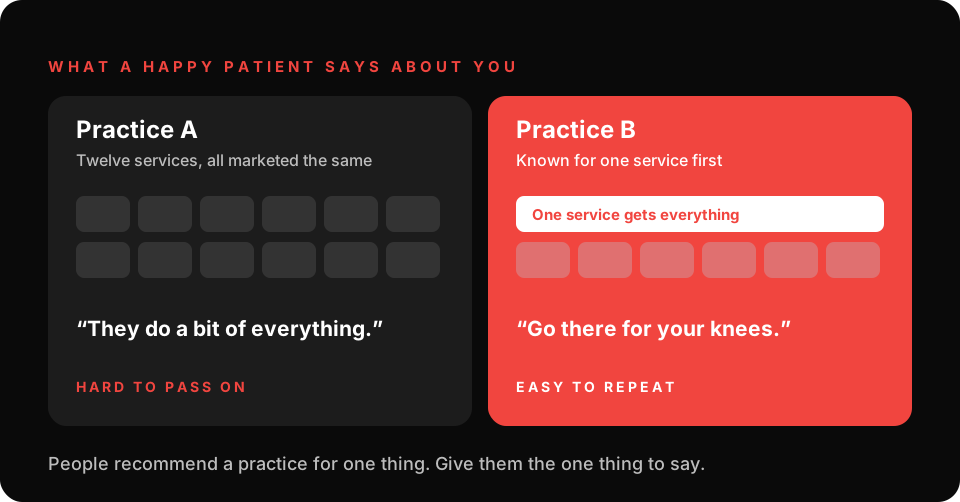
8 healthcare branding strategies beyond search
- Be known for one service first. The rest can wait.
- Write a promise patients can repeat. One plain sentence a patient could say to a friend without looking it up. If it needs a brochure, it’s too long.
- Ask for reviews that name the treatment. “My knee surgery was easier than I expected” sells the next one far better than “great staff”. Ask every patient, and never offer anything in return, which Google’s tips for getting more reviews say is strictly prohibited.
- Treat the phone call as the brand. More on that below.
- Give them the first taste. A few minutes, free.
- Use real photos of the real team. The doctor, the front desk, the actual rooms. Google’s own tips for business photos ask for team photos that humanize the business and images that represent reality.
- Keep one look and one voice everywhere. Same colors, same name, same way of talking on the website, the forms, the reminder texts and the sign on the door.
- Put the doctor on video. One question per clip.
None of these need a big budget to start. They need someone to decide that the brand is the whole experience, and then hold everyone to it.
The front desk is half your brand
Most practices spend money on a logo and leave the phone to whoever’s free. But the call is the first time a patient actually talks to you, and they judge the whole practice on it. A rushed “please hold” after a beautiful website undoes the website.
So we look at what happens to an enquiry after it arrives. How long the reply takes, whether someone can answer the price question, whether the patient leaves the call with a date. Those are patient engagement strategies that start on the first call, and they shape how people talk about you more than any tagline.
Not sure what a patient hears when they call you?
Let us check it for you →How the doctor shows up on video
Patients can’t judge a surgeon’s hands, but they can judge whether they’d feel comfortable in the room. A short video of the doctor explaining one thing in plain words does more for trust than a wall of certificates. There are plenty of healthcare video marketing ideas for a phone camera to start from.
Keep it simple. A phone on a stand, good light, one question per clip, answered the way the doctor would answer it in the consult room. Scripts make most doctors sound like they’re reading, and patients are watching for kind and clear. Then keep the look the same as everything else, so someone who saw the clip on Instagram recognizes the practice when they walk in.
Never filmed the doctor and not sure where to start?
Let us plan the clips for you →How to tell the brand is working
Listen at the front desk. When new patients start saying “my friend told me to come here for my knees”, in roughly the words of your promise, it’s working. When they ask for the service by name instead of describing a symptom, it’s working too. Ask every new patient how they heard of you, and write the answer down.
The bigger test comes when the ads go quiet. Ads bring bookings in the first week, so we usually run PPC for healthcare that fills the calendar early while the brand builds underneath. Once the brand carries its weight, a slow month on ads doesn’t empty the calendar, because people are already asking for you.
Find out what patients remember about you.
Six questions, then learn about the marketing opportunities in your area, including how your practice comes across before and after the first call.
Get your assessment →