Healthcare Marketing Analytics: What to Track
Clicks and impressions won’t tell you if a single patient walked in. These are the numbers that will, from the click to the treatment.
Most practices get a monthly report full of clicks, impressions and a click through rate, and none of it tells them whether a single patient walked in. Healthcare marketing analytics that count booked patients start from the other end: the patient in the chair, and what that patient was worth.
So this is the short list of numbers we actually watch, where each one sits between the click and the treatment, and how to track all of it without sending patient details to an ad platform.
What healthcare marketing analytics should answer
There’s really one question behind all of it. For every dollar that went into ads, how many patients went ahead with treatment, and what were they worth? Everything else on the report is there to explain why that answer moved.
The trouble is that ad platforms report what they can see. Google sees the click. Meta sees the form. Neither of them sees your front desk miss the call, or the patient who booked and never turned up, or the one who sat through the consultation and said she’d think about it. So the dashboard looks healthy, the schedule stays half empty, and the practice keeps paying for it.
From click to treatment
Think of it as a chain. Somebody clicks, then calls or fills in a form, someone at the practice answers, they book, they show up, and they go ahead. Each link has its own number, and a practice can lose people at any one of them.
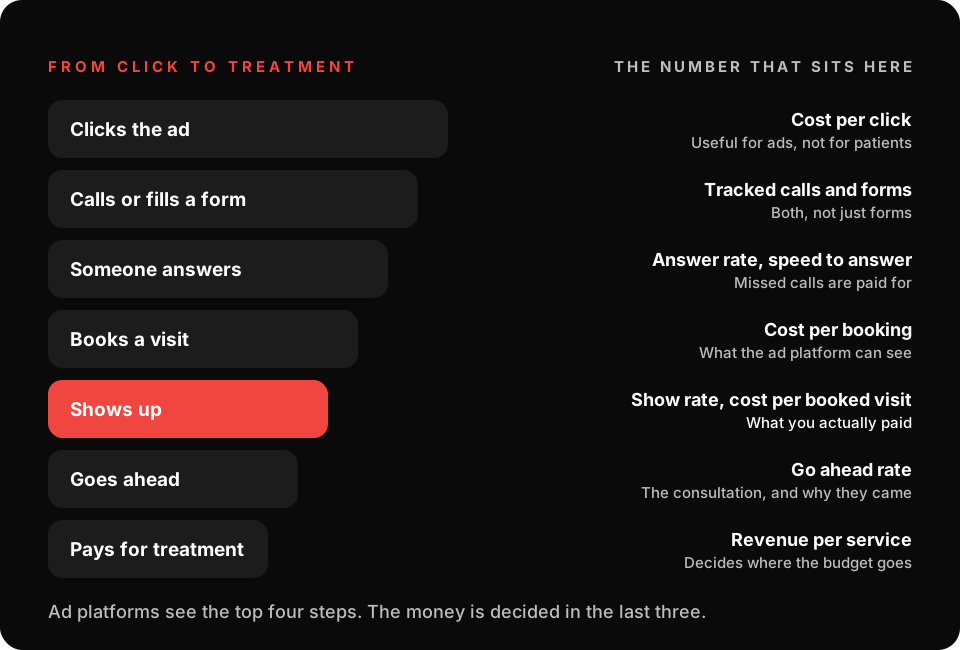
Most reports stop at the second link. Most of the money gets lost after it, in places the agency never looks because the ad account can’t show them.
7 numbers worth tracking
- Cost per booked visit. Your ad spend divided by the visits that actually happened. Bookings that never showed up don’t count. It’s the number we optimise for, and the one that tells you whether everything else is working.
- Calls, tracked. Plenty of patients would rather phone than fill in a form, especially for anything urgent or private. Count only forms and you’re blind to a big share of what the ads bring in. Google Ads can track calls from your website as conversions, and only counts a call once it passes a minimum length you set.
- Answer rate. Of the calls that came in, how many did a person pick up. Every missed call is a patient you paid for and handed to the practice down the street.
- Speed to answer. For forms and missed calls, how long until someone got back to them. Minutes, not the next morning, because they’re still comparing you with two other practices.
- Show rate. Of the people who booked, how many came in. A low one usually means the slot was too far out or nobody reminded them.
- Go ahead rate. Of the people who came in for a consultation, how many went ahead. A lot of it depends on patient acquisition after the first visit, and on why they came in at all.
- Revenue per service. What each service brought in against what it cost to market. This is how you decide which service gets the budget next.
Seven sounds like a lot. In practice you look at the first one every week, and you only open up the other six when it moves the wrong way.
No idea how to get calls, bookings and visits into one report?
Let us set up call tracking for you →What to stop watching
Clicks, impressions and click through rate aren’t useless. We look at them when we’re writing and testing ads. But on their own they say nothing about patients, and a report built around them can look better every month while bookings go nowhere.
A cheap click from someone in the wrong city, or someone who only wanted free advice, is still a click, and a campaign told to get clicks will find plenty of those. That’s why we run PPC for healthcare optimised for booked visits, so the platform learns from the people who came in instead of the people who browsed.
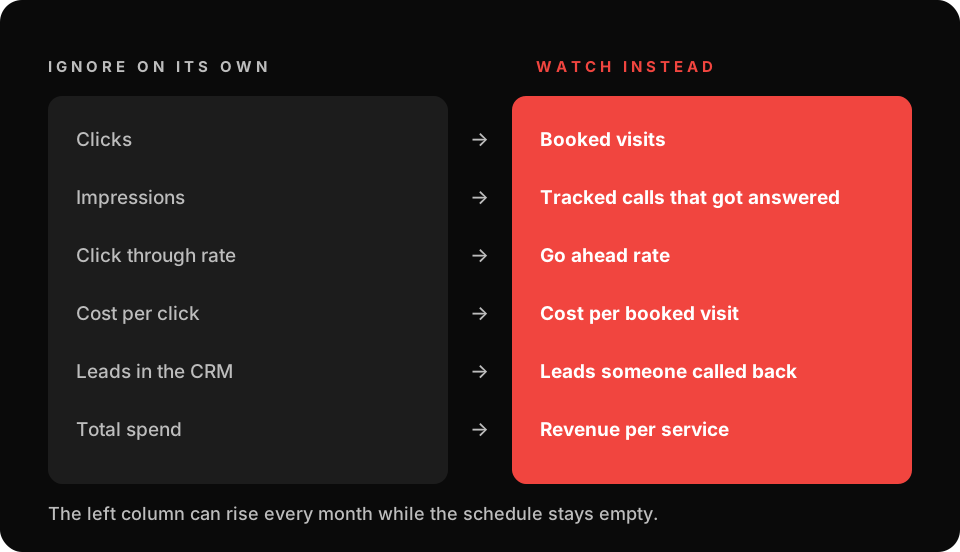
Leads in the CRM belong on the left too. A lead nobody called back is just a cost with a name on it.
An example: why show rate changes everything
Here’s a made up example with round numbers. Say a practice spends $1,200 a month on one service and gets bookings at $40 each. That’s 30 bookings. If 20 of them show up, the real cost per visit is $60. If the front desk adds reminders and 25 show up, it drops to $48 without anyone touching the ads.
That’s the whole point of tracking the chain. The fix for an expensive patient is often inside the practice, and you’d never spot it from a click report. Patient engagement strategies that lift the show rate are usually cheaper than more ad spend.
Bookings look fine, but the chairs are half empty?
Let us find where patients drop off →Tracking it without breaking HIPAA
This is where a lot of practices get into trouble without knowing it. A standard pixel on a booking confirmation page can send the ad platform far more than it should: what the patient booked, sometimes their name or email. The HHS bulletin on tracking technologies says practices can’t use tracking in a way that discloses protected health information to the vendor, and that handing it over for marketing without the patient’s authorization is an impermissible disclosure.
So we split it. Patient details stay in a HIPAA compliant CRM and your practice system. What goes to Google or Meta is a neutral event sent server side: a booking happened, a visit happened. No name, no procedure, nothing that says who it was. It’s enough for the platform to learn which ads bring patients, and it’s the same line drawn in HIPAA compliant marketing for clinics.
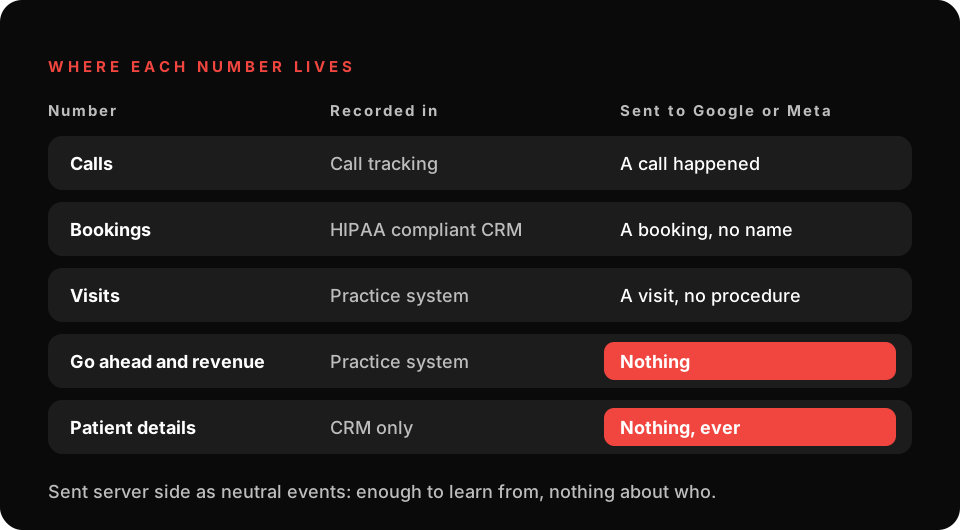
Go ahead rate and revenue never leave the building. You need them to judge the marketing, and the ad platform has no business seeing them.
Not sure what your booking page is sending to Google or Meta?
Let us check your tracking for you →Reading the numbers
Check cost per booked visit every week for each service, and the rest once a month. When the cost goes up, walk the chain from the top. Fewer calls points at the ads or the page. Calls but no bookings usually means the phone, which is a big part of why Google Ads don’t work for some practices. Bookings with empty chairs means reminders. Visits with no treatment means the consultation, or the wrong patients being sent in.
And judge each service on its own. We market one service at a time, and revenue per service is how you know the first one is steady enough to add the next. If you’re still setting a healthcare marketing budget per service, these are the numbers that tell you whether to raise it. Good healthcare marketing analytics don’t need a big dashboard. They need the phone, the schedule and the ad account joined up.
Find out where your practice is losing patients.
Six questions, then learn about the marketing opportunities in your area, including which step between the click and the treatment needs fixing first.
Get your assessment →