Healthcare Marketing Budget: How Much to Spend
Where the money goes, what we start one service with, and why the budget should come from what a booking costs, not from a percentage of revenue.
“How much should we spend?” is usually the first thing a practice asks us, and it’s fair. But most of the numbers floating around start from the wrong end. A healthcare marketing budget built backwards from bookings starts with what a new patient is worth to you and what one costs to book, and the monthly figure falls out of that.
So here’s where the money actually goes, the number we start one service with, and why a percentage of revenue tells you very little.
Where a healthcare marketing budget goes
There are four places money goes, and they don’t pay you back at the same speed. Ad spend is what you pay Google or Meta. Management is what you pay whoever runs it, and it’s separate from the ad spend. Tools are the CRM, call tracking and compliant tracking that tell you which patients came from where. Content is the pages, photos and videos that patients read before they book.
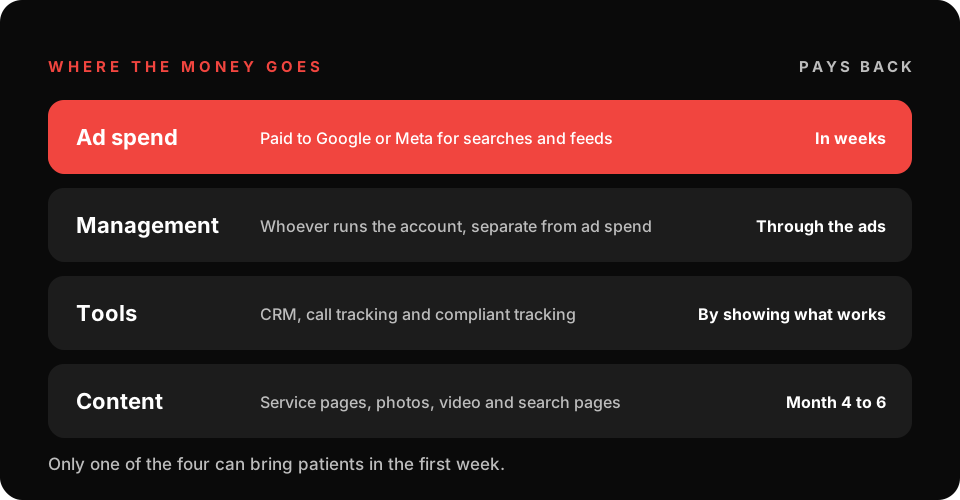
The mistake we see most is a practice spending heavily on content and a new website first, then running out of money before the ads go live. Content matters, and healthcare branding through search pages is what eventually lowers your cost per patient. But it pays back in months, and the ads pay back in weeks. So the ads go first.
Not sure how much should go on ads and how much on everything else?
Let us split the budget for you →Start with about $1,200 a month for one service
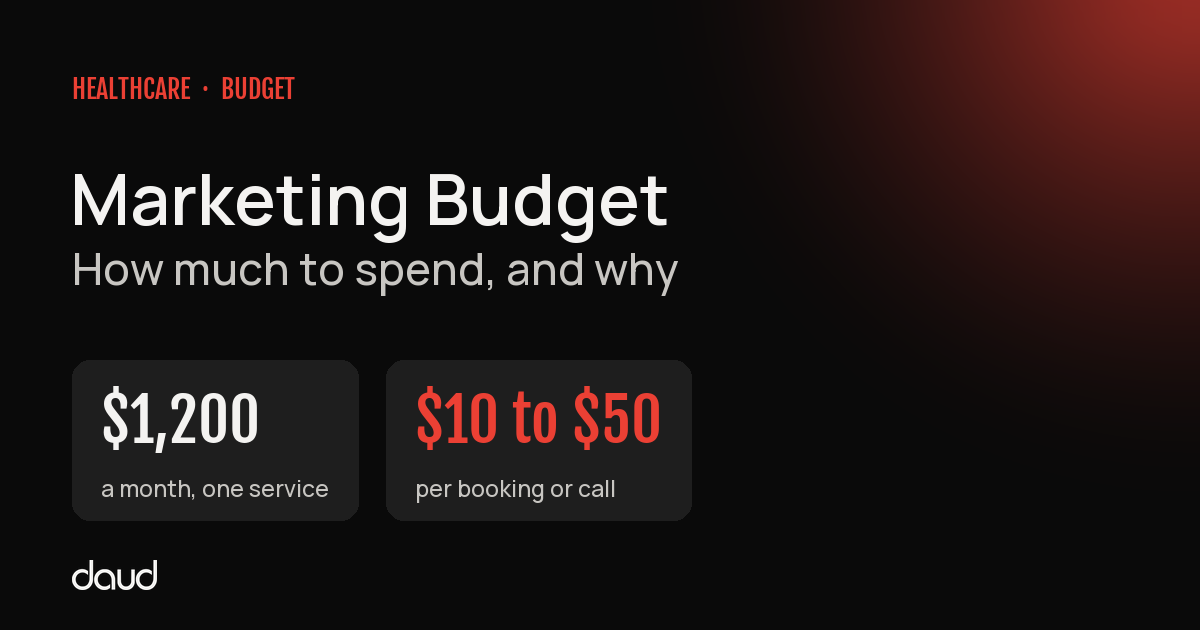
We start PPC for healthcare tuned to bookings and calls at around $1,200 a month of ad spend on Google, for one service at a time.
In Google’s own terms, that’s an average daily budget of about $40. Google can spend up to twice that on a busy day, but over a month it won’t charge more than 30.4 times the daily figure, according to Google Ads help on average daily budgets. So a quiet Tuesday and a busy Monday even out, and the month stays at what you set.
Working backwards from the cost per booking
The number we actually watch is what each booked appointment or call costs. On Google in healthcare, that usually lands somewhere between $10 and $50, depending on your area, how many practices bid on the same searches, and how much explaining the treatment needs. Put that next to the $1,200 and you can see roughly what a month buys.
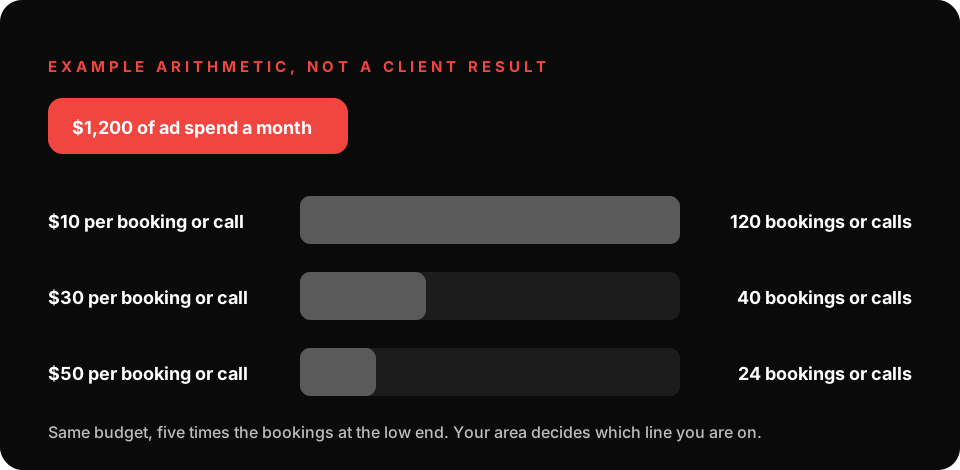
Then turn it around. Here’s an example, not a client result: say a treatment is worth $3,000 to the practice and one booked consultation in five goes ahead. Each booking is then worth about $600 to you. Anything you pay per booking below that is making money, and anything near it isn’t. Your numbers will be different, and that’s the point. The budget comes from them.
Don’t know what a patient is worth to you, or what a booking costs in your area?
Let us work out your numbers →Healthcare marketing budget percentage: the wrong place to start
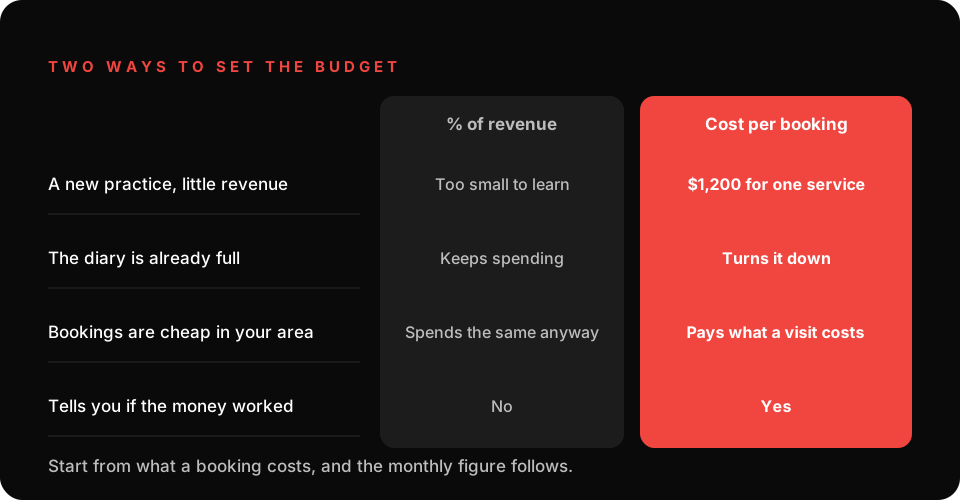
A lot of people ask what percentage of revenue a practice should spend. We don’t give one, and we couldn’t find an official source that does either. The SBA’s guide to writing a marketing and sales plan asks you to break down the costs and compare them to the revenue they bring in. That’s working backwards, and it’s what we do.
A percentage of revenue starts from what you already earn, which has nothing to do with what a patient costs in your area. A new practice with little revenue ends up with a budget too small to learn anything. An established one with a full diary keeps spending because the rule says so. And none of it tells you whether the money worked.
Where the $11 lead fits
Some treatments barely get searched. Very few people type the name of a weight loss surgery into Google, even though plenty of them are worried about their weight. For a weight loss clinic like that, we ran Facebook and Instagram ads instead, and a second clinic using the same approach got to $11 per lead.
That’s a social ads number, not a Google one, and a lead isn’t a booking. Someone who fills in a form on Instagram is earlier in their decision than someone who searched and called. So compare like with like: cost per booked visit on both, once the follow up has done its work. Which platform gets the money first is the question behind healthcare lead generation across Google and Meta.
7 steps to set a healthcare marketing budget
- Pick one service, and the right one. One budget spread across twelve services never gets enough for any of them to learn, and one budget on the wrong treatment is a needle in a haystack.
- Work out what a patient is worth. What the practice earns from someone who goes ahead with that treatment.
- Set a ceiling per booking. The most you can pay for a booking and still make money on it.
- Start the ads at about $1,200 a month. Enough for one service to show what a booking costs in your area.
- Pay for tracking before content. If bookings aren’t counted, you can’t judge any other line in the budget. Counting them is what healthcare marketing analytics built on booked visits are for.
- Judge on bookings once the numbers settle. Not on clicks, and not after three days.
- Fund the next service from the first. Add it when the first one books on its own, with its own budget.
Not sure which treatment deserves the budget?
Let us pick it with you →When to spend more
We raise a budget when the cost per booked visit has held steady for a while and the front desk is keeping up. If calls are going unanswered, more ad spend just buys more missed calls. And when the first service is booking reliably, the next step usually isn’t more money on the same service. It’s a second service, with its own page and its own budget.
Adding that second service is the last step of a healthcare marketing strategy for the first 90 days, and it only comes once the first one passes a few tests. And part of every budget should go on keeping the patients you’ve paid for, which is what patient engagement strategies for repeat visits do for very little money.
Find out what a booking should cost you.
Six questions, then learn about the marketing opportunities in your area, including where your first $1,200 would go furthest.
Get your assessment →