Healthcare Marketing Strategy: A 90 Day Plan
What a practice does in its first 90 days of marketing, in the order it does it: ads live in week one, a few services tested, and the winner backed.
Most practices that ask us for a plan already have a list of ideas. A new website, some posts, maybe ads for everything they offer. What they don’t have is an order to do it in. A healthcare marketing strategy that tests before it commits is mostly about that order, and the first 90 days decide whether the rest of it ever happens.
So this is the plan we run with a practice in its first three months: what happens when, what we judge at each checkpoint, and what we deliberately leave for later.
Why a healthcare marketing strategy fits in 90 days
Two things set the clock. Ads usually bring enquiries in their first week live, because they catch people who are already looking. SEO, Google Maps and AI answers take 4 to 6 months to rank in a mildly competitive market. So 90 days is long enough to find the service that books and prove it, and short enough that nobody loses patience. It’s also the point where the slow work has to be started, or it won’t pay off until next year.
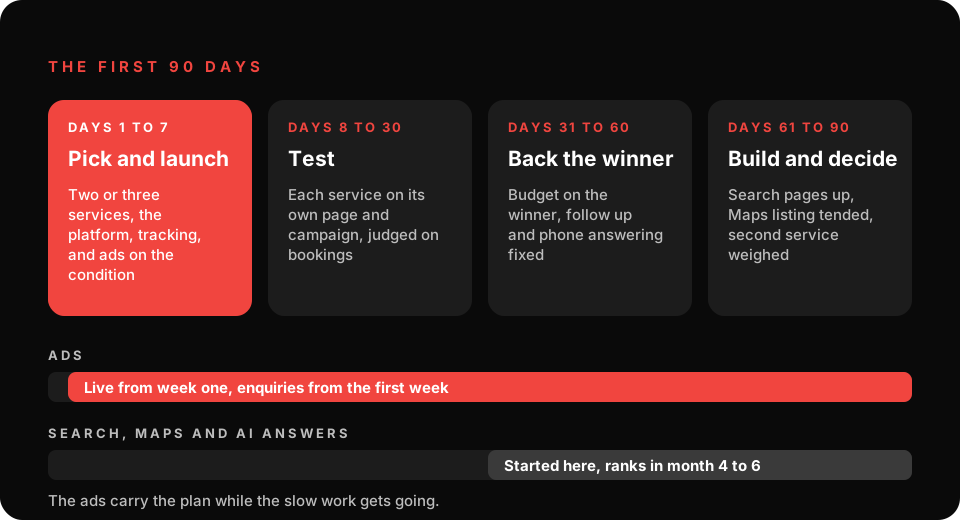
Notice the bottom line in that picture. The organic work starts inside the 90 days but pays off well after them. That’s why the ads come first, and why they go live in the first week. They pay for the months the rest of it needs.
10 steps in the 90 day plan
- Week 1: pick two or three services to test. Ones with a good margin, real demand, and room in the diary to take more of them.
- Week 1: decide the platform. Do people search for these conditions on Google, or do you have to find them on Facebook and Instagram?
- Week 1: set up tracking that stays compliant. Bookings and calls counted, nothing about the patient sent to an ad platform. Those counts feed the healthcare marketing analytics worth checking weekly.
- Week 1: launch the ads on the condition. One campaign per service, in the words patients use, each landing on its own simple page with a price range and a call button.
- Weeks 2 to 4: let the test run. Same rules for every service, and nobody touches it because one had a slow Tuesday.
- Week 5: back the winner. The service with the cheapest bookings that actually turn up gets the budget. The others pause until it’s their turn.
- Weeks 5 to 8: fix the follow up. This is where we see most practices lose patients.
- From the first patient: ask every patient for a review. Every one, not just the ones you expect to be happy.
- Weeks 9 to 12: put up the search pages for the winner. They take months to rank, so they go up now.
- Day 90 or later: bring back the next service. Usually the runner up from the test, and only once the winner books without anyone pushing it.
None of these are clever on their own. What makes it work is the order, and not skipping ahead to step ten in week three.
Not sure which two or three services belong in the test?
Let us pick them for you →Platform first, then the services
Before anyone writes an ad, there’s one question: where are these patients looking? Patients type the problem, not the specialty, so for most treatments the first campaign is PPC for healthcare aimed at the condition. But some treatments barely get searched at all. The need is there, people just don’t type it into Google. Those run on Facebook and Instagram instead, and that call is what healthcare lead generation on Google or Meta is about.
The tools to check this are free. Google’s Keyword Planner shows roughly how many people search for a condition near you, and the Meta Ad Library shows every ad your competitors are running right now. The trouble is reading them. Keyword Planner hands you hundreds of terms, half of them from people who want a job or a textbook, and the Ad Library shows you what others run without telling you whether any of it books a single patient.
Keyword lists and the Ad Library are a lot to read for a practice owner.
Let us figure it out for you →Testing two or three services at once
Starting with one service is the ideal, but only if it’s the right one. Pick the wrong procedure and you’re looking for a needle in a haystack. Practices usually want to start with the thing they’re proudest of. That’s a guess. Instead of guessing, we put two or three services live in the first week, each with its own campaign, its own page and its own share of a small test budget, aimed at the right people on the platform we picked.
Three or four weeks is usually enough to see a pattern. One service books cheaper, or books patients who actually turn up, or both. That’s the one that gets the money. The others don’t get thrown away; they’re next in line, and they already have a page and an ad ready to go.
If you’d rather run the test yourself, go ahead. Same rules for each service, its own page each, and judge it on bookings that turned up, not clicks.
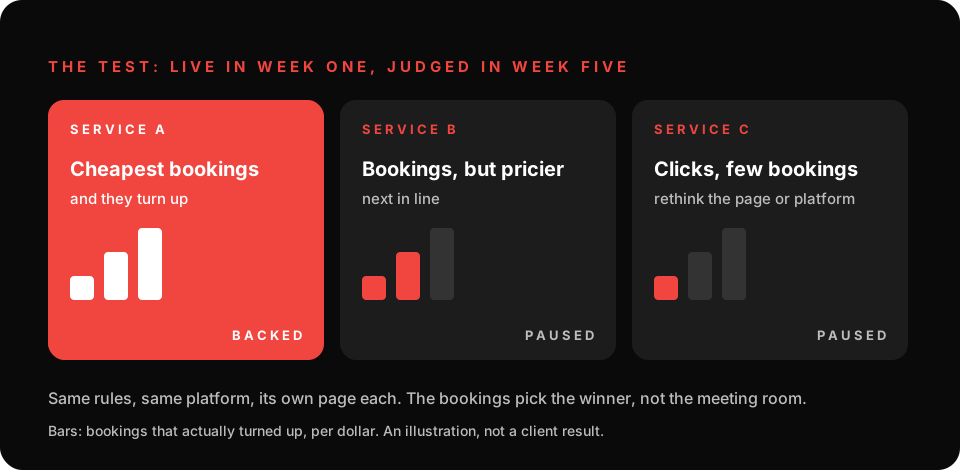
The test is also the cheapest lesson the practice will ever get. A month of real bookings tells you more about your market than any amount of planning in a meeting room.
What to judge at each checkpoint
A healthcare marketing strategy without checkpoints is just a calendar. We look at four points in the 90 days, and at each one there’s a single question. If the answer is no, we fix that before moving on, even if it means the next phase starts late.
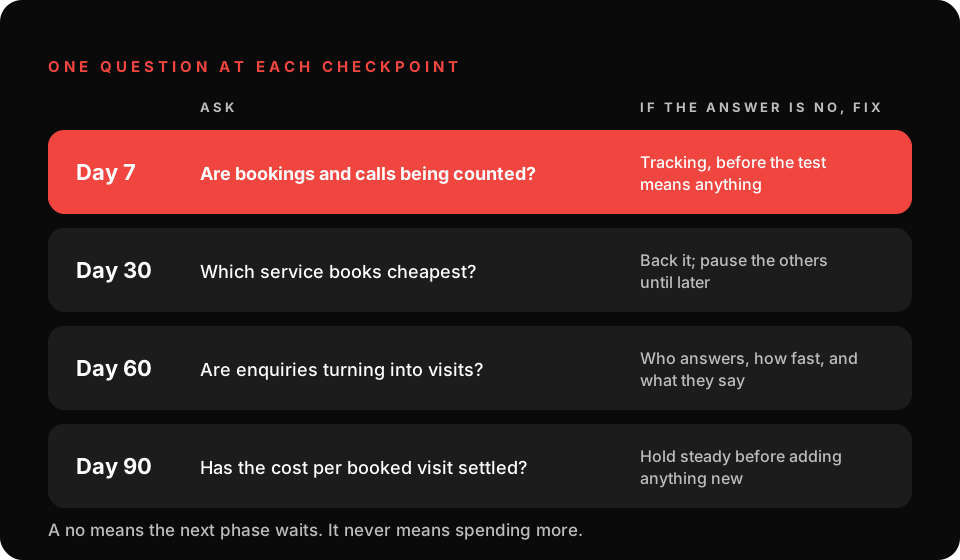
The day 7 checkpoint is the one people skip, and it’s the one that matters most. If tracking isn’t counting bookings properly, the whole test is a guess. In healthcare it also has to be done right: the HHS guidance on online tracking technologies warns that a pixel on a booking form can send patient details to the platform. We send the ad platforms that a booking happened, and nothing about who made it.
Worried your tracking sends more than it should?
Let us set it up for you →Most of the fixing happens after the click
Somewhere around week five, most practices have the same problem. The ads are bringing enquiries, but fewer of them turn into appointments than they should. Usually the ads aren’t the issue. Calls go to voicemail at lunch, forms get answered the next afternoon, and the person who was ready to book has already called the practice down the road.
So the middle of the plan is mostly operations. Who picks up, how fast, and what they say. It also helps to sort enquiries by why they came, because someone in pain needs a different conversation from someone thinking about a cosmetic procedure. That split is the heart of patient acquisition after the first consultation. Asking for insurance details up front helps too, since a patient who has checked their benefits online is a warmer call than one who hasn’t.
Fix this and the same ad spend books more visits. That’s why we don’t touch the budget until the follow up is sorted.
Enquiries coming in, but the diary isn’t filling?
Let us find the leak →When to add the next service
Day 90 isn’t an automatic green light. The next service comes back when the winner passes three tests, and not before. If it passes on day 70, great. If it takes until day 120, that’s fine too.
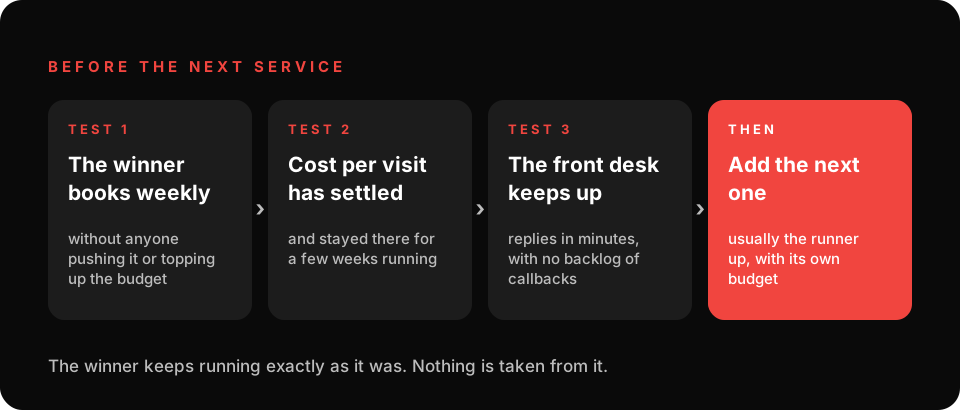
Once it does, the next service gets its own budget, and the winner keeps running exactly as it was. That’s how we grow every practice we work with. How much that next step costs is a question for the healthcare marketing budget for each new service, and it’s easier to answer once the first one has real numbers behind it.
What waits until after day 90
A lot of good ideas don’t belong in the first three months. A full website redesign, videos for every treatment, a blog with forty posts, a push on Instagram for brand awareness. Some of them are worth doing. None of them will tell you within 90 days whether your marketing books patients.
The one slow thing we do start early is search. The pages for the winning service go up in the last month of the plan, every patient gets asked for a review from the first one onwards, and the Maps listing gets looked after every week. Google’s own tips for getting more reviews come down to asking, with a link or a QR code, and replying properly. By month six that work turns into healthcare SEO and AI answers that rank on their own, and the ads stop carrying everything.
And once those first patients are in, patient engagement strategies after the first appointment are what bring them back for the next one.
Let us plan your first 90 days.
Six questions, then learn about the marketing opportunities in your area, including which services we’d put in your first test.
Get your assessment →