Is Marketing Worth It for a Medical Practice?
Sometimes it is, sometimes it isn’t yet. Here’s how to tell which, before you spend a dollar.
Most practice owners we speak to have paid for marketing at some point and couldn’t tell you what came of it. So it’s a fair thing to ask before doing it again: is marketing worth it for a medical practice like yours? Sometimes it is, sometimes it isn’t yet, and you can usually tell which before you spend anything.
So here’s the honest version. Why it matters in healthcare at all, what the arithmetic looks like, a real result, and the situations where we’d tell you to keep your money for now.
Why marketing is important in healthcare
Patients don’t pick a doctor the way they used to. They search the problem, ask an AI, read the reviews and compare two or three practices before they call anyone. If you’re not on that shortlist, the quality of your care never gets a chance to count.
Referrals still matter, and referral patients are great patients. But they have a ceiling. You only get as many as your network sends, and you can’t turn that up in a month when the schedule has room. That’s why patient acquisition past the referral ceiling has to come from people finding you on their own.
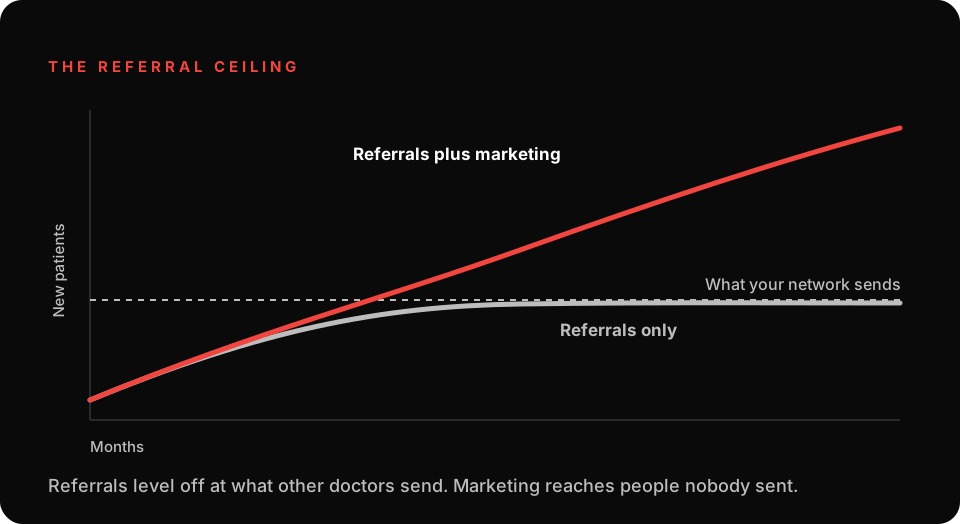
Marketing is how you get past that line. It puts you in front of people who have the problem today and nobody to send them anywhere.
Is marketing worth it? Do the arithmetic
We usually start one service on about $1,200 a month in ad spend. On Google, a booking or a call tends to cost somewhere between $10 and $50, depending on your area, who else is bidding and the practice itself.
What $1,200 buys at each end of that range is laid out under a healthcare marketing budget that grows one service at a time, so the only question here is whether the patients who go ahead from those bookings and calls bring in more than $1,200 of profit.
For a high value procedure, one or two patients going ahead can pay for the whole month. For a routine visit with a thin margin and nothing that follows it, the sums get tight very quickly. That’s why we pick the first service carefully, usually the one with the best margin or the most demand, and put the whole budget behind it.
Not sure which of your services would actually pay for its ads?
Let us run the numbers for you →A real result: a weight loss surgery clinic
Very few people search for bariatric surgery by name. But when we looked at the area, plenty of people were worried about their weight. The need was there. People just weren’t searching for the surgery.
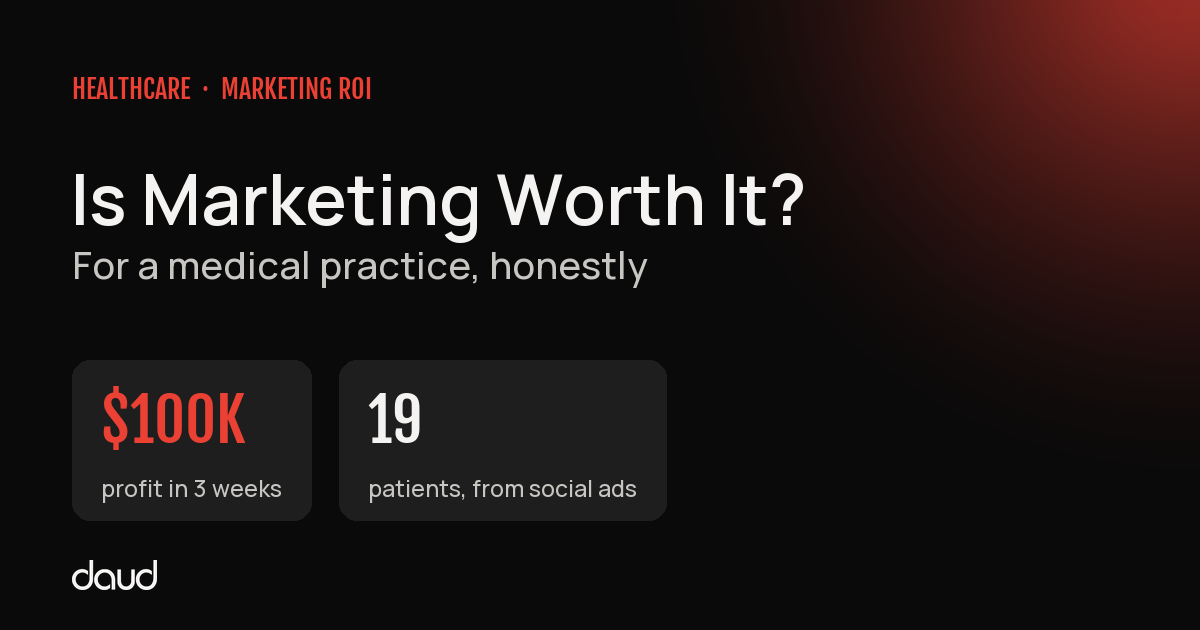
So we skipped Google Ads for it and went to Facebook and Instagram, and the SEO went after weight loss and obesity terms instead of procedure names. That clinic made $100K in profit in 3 weeks, from 19 patients. A second weight loss clinic using the same approach got $11 per lead on social ads. Choosing the platform that way is what healthcare lead generation on Facebook and Instagram comes down to.
So is marketing worth it? For that clinic, needless to say, it was. It worked because we went where those people already were.
When marketing isn’t worth it (yet)
We tell practices to wait more often than you’d think. If the schedule is already booked out for months, more enquiries just mean longer waits and annoyed patients. Fix capacity first, or market only the one service that has room.
If nobody answers the phone, or form enquiries sit until the next morning, you’ll pay for patients and hand them to whoever picks up first. That’s the most common way we see marketing fail, it has nothing to do with the ads, and it’s a big part of why Google Ads don’t work for some doctors.
And if the treatment barely covers its own costs, there’s nothing left over to pay for the patient. Market something else first and let that one come along through word of mouth and follow up. Spreading $1,200 across ten services goes in the same pile, because none of them gets enough to learn who books.
Worried calls would go unanswered once the ads start?
Let us check your phones and follow up →When the return shows up
Ads usually bring bookings in the first week, because they catch people who are already looking. Search is slower. Healthcare branding on Google Maps and in AI search takes 4 to 6 months to rank in a mildly competitive market, so the ads carry the first months while that builds underneath.
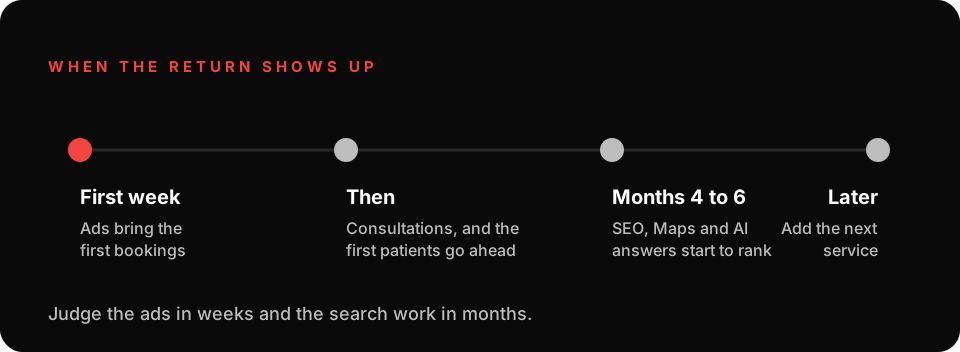
A lot of practices quit at month two, two to four months before search usually starts to pay. Judge each part on its own clock.
6 questions to ask before you spend
- Do you have room? Name the service that could take more patients next month without a waiting list.
- Who answers while the ads run? A named person during the hours the ads are live, and a plan for missed calls.
- Which one service has the margin? Start with that one, and leave the rest of the menu for later. Choose it carefully, because the wrong treatment is a needle in a haystack.
- Do people search for it, or only for the problem? If they search the condition, Google tends to fit. If they only think about it, social does.
- Can you see what came of it? Calls tracked, bookings and visits recorded, and healthcare marketing analytics from click to treatment so you know the cost per patient, not per click.
- Can you give it time? Weeks for the ads to settle, and months for search.
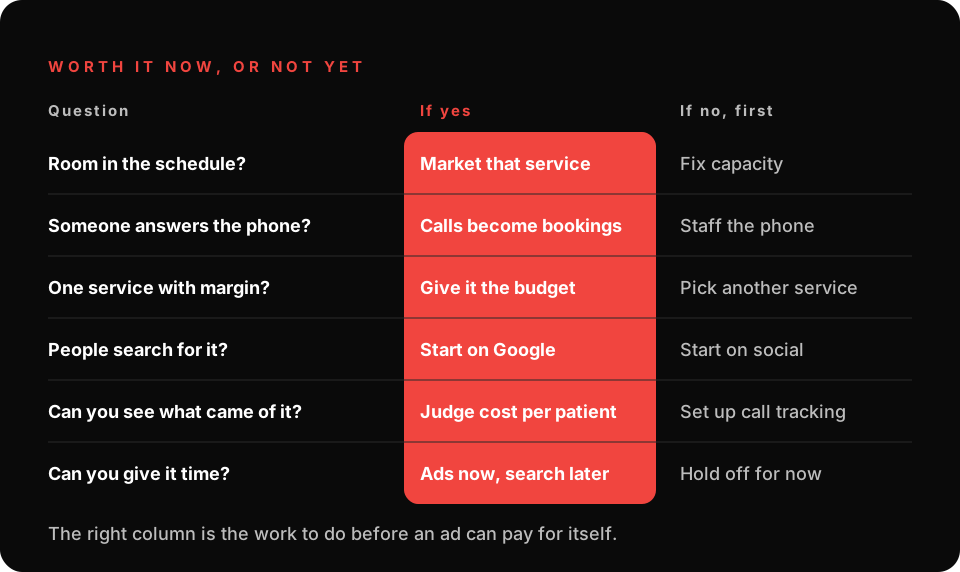
If you can answer five of these, marketing is very likely worth it for you now. If you’re stuck on the first two, fix those before you spend anything, because no ad will fix them for you.
Where to start
If you’re wondering how to promote your medical practice without a big launch, start with what’s free. A complete Google Business Profile, and reviews coming in every month. Google says more reviews and positive ratings can help your local ranking, and it’s the listing people check before they call.
No time to sort out your Google listing and get reviews coming in?
Let us set up your listing for you →Then add one paid service, once someone is ready to answer the phone. That order is the backbone of a healthcare marketing strategy for the first 90 days, and it’s how you find out whether marketing is worth it for your practice without betting the year on it.
Find out if marketing would pay for your practice.
Six questions, then learn about the marketing opportunities in your area, including which service we’d start with and whether now is the right time.
Get your assessment →