Healthcare Marketing Trends for 2027
Patients ask AI first, click less, and expect a price and a fast reply. Here’s what’s changing for practices in 2027, with the sources, and what we’d do about it.
Every year there’s a fresh list of things a practice is supposed to jump on, and most of them never touch a single booking. So this one is short and practical. These are the healthcare marketing trends that change who gets booked, each with a source where a platform or a regulator is involved, and what we’d actually do about it.
How we picked these healthcare marketing trends
One test. Does it change how a patient finds a practice, picks one, or comes back? If it doesn’t, it’s not on the list, however much it gets talked about. Where something is a rule or a platform change, we’ve linked the source. Where it’s something we’re seeing across our own clients, we say so and leave the numbers out.
8 healthcare marketing trends for 2027
- Patients ask AI before they search. More people start with a chatbot, so your answers need to be on your own pages, in plain words, where an AI can pick them up.
- Fewer clicks from the results page. When Google answers the question itself, fewer people click through, so your Maps listing and your name do more of the work.
- Tracking moves server side. Sending health details to ad platforms through a pixel is a legal risk, so the setup has to send neutral events and keep the rest in your CRM. What you read from it then is healthcare marketing analytics that end at the booking.
- Ad platforms tighten health targeting. You can’t follow people around based on a condition, so the search and the page have to do it in one go.
- Short vertical video from the doctor. Patients look for health advice on social media, and a doctor explaining something on camera beats any stock footage. A dozen healthcare video marketing ideas for doctors cover most of what to film.
- Reviews and price ranges decide the shortlist. In our experience, practices with thin reviews and no price get dropped before the call.
- Follow up speed wins the patient. The practice that answers first usually gets the booking, which makes automation a front desk tool rather than a nice extra.
- Real experience on the page. Health is a topic where Google wants accuracy and expertise, so a named doctor and real cases count for more than another generic article.
Most of these pull in the same direction. The patient does more of the deciding before they ever reach you, so whatever they find on the way has to be right.
Patients ask AI first, and click less
This is the biggest change. A KFF poll from June 2026 found 29% of adults use AI tools or chatbots for health information and advice every month, up from roughly one in six two years earlier. That’s the self diagnosing stage, and it’s where a lot of shortlists now start.
At the same time, Google itself answers more questions on the results page. Pew Research found that people who saw an AI summary clicked on results far less often, and hardly ever clicked the links inside the summary.
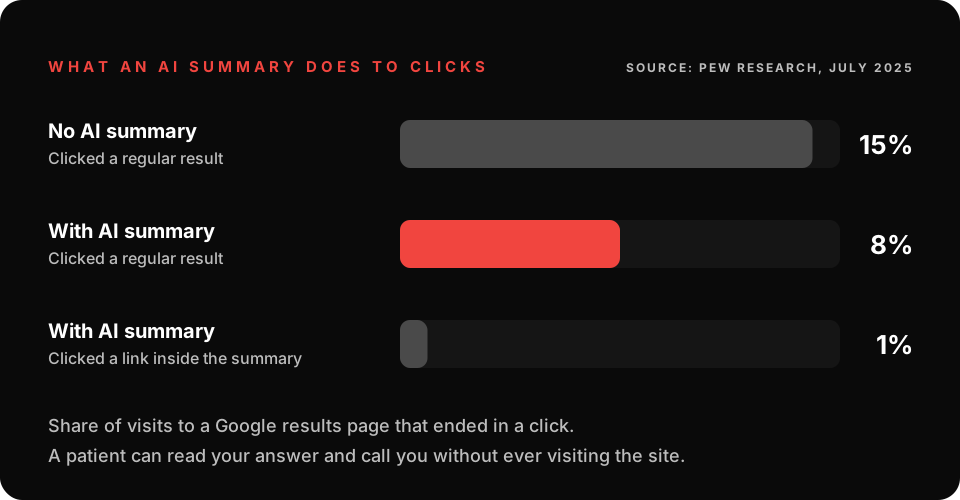
So what do you do? Google says there are no special requirements to appear in AI Overviews beyond being indexed and eligible for a snippet. No tricks, no special markup. It comes down to pages that answer the questions patients ask, in their words, which is what healthcare branding for AI answers is built on. And stop judging the website by traffic. Count bookings and calls, because a patient who read your answer in a summary and then called you never shows up as a visit.
No idea what an AI tells patients about you?
Let us check your AI answers →Privacy and ad rules are getting tighter
The FTC has been clear that HIPAA isn’t the only rule in play. Its guidance on collecting and sharing consumer health information says the FTC Act applies to HIPAA covered entities too, and that disclosing health information for advertising without affirmative express consent may be an unfair practice. It also calls out tracking tools that share health data in a way that contradicts your own privacy promises.
The ad platforms have tightened as well. Google lists health as a sensitive category in its personalized advertising policy, so you can’t target people by their condition. And with our own clients we’ve watched Meta limit which booking events health advertisers can send it, which quietly breaks campaigns that rely on a standard pixel.
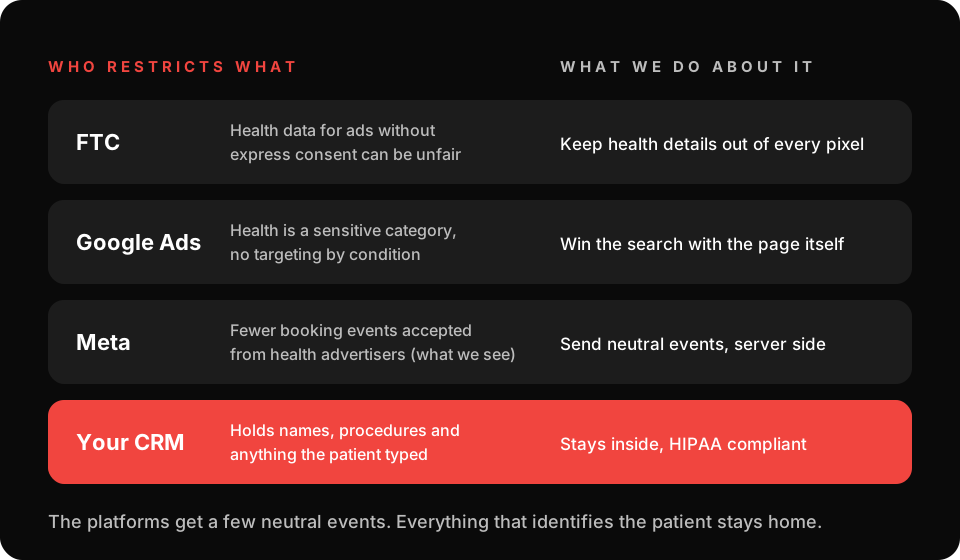
Our answer is the same everywhere. Names, procedures and anything a patient typed stay in a HIPAA compliant CRM, and the platforms get a few neutral events matched server side. That’s the core of HIPAA compliant marketing with server side tracking, and it’s enough for the platforms to optimise. On Meta in particular, it’s the difference between healthcare lead generation on Meta that still learns and a campaign that stops learning.
Worried your pixel sends patient details to Meta or Google?
Let us move your tracking server side →Reviews, price and speed decide the shortlist
Reviews have always mattered, and Google says plainly in its local ranking tips that more reviews and positive ratings can help a listing. What we’re seeing now is patients reading them more closely, looking for the treatment they want and for how recent the reviews are.
Price is the other one. Patients paying for themselves are already used to getting a number up front, because CMS says providers usually have to give a good faith estimate to anyone not using insurance who books at least 3 business days ahead. A page with a price range filters out the people who were never going to book, and the rest arrive having already accepted the number.
Then speed. Across our clients, the practice that replies first tends to get the booking, and a reply the next morning often finds a patient who’s already booked elsewhere. That’s why we build healthcare automations for fast follow up, and why we let patients verify insurance while they’re still on the page. All three are how patient acquisition decided on the shortlist works now.
Replies going out the next morning?
Let us speed up your follow up →Video and real experience fit in here too. KFF found that three in ten adults use social media for health information or advice every month, and Google gives more weight to experience and expertise on health topics. A short vertical video of the doctor explaining a treatment does both jobs at once. For visual treatments, a procedure try-on before they enquire goes one step further.
Where to start in 2027
You don’t need all eight at once. We’d start with the ones that stop money leaking, then build the slow ones underneath, the same way we build digital marketing for healthcare in order.
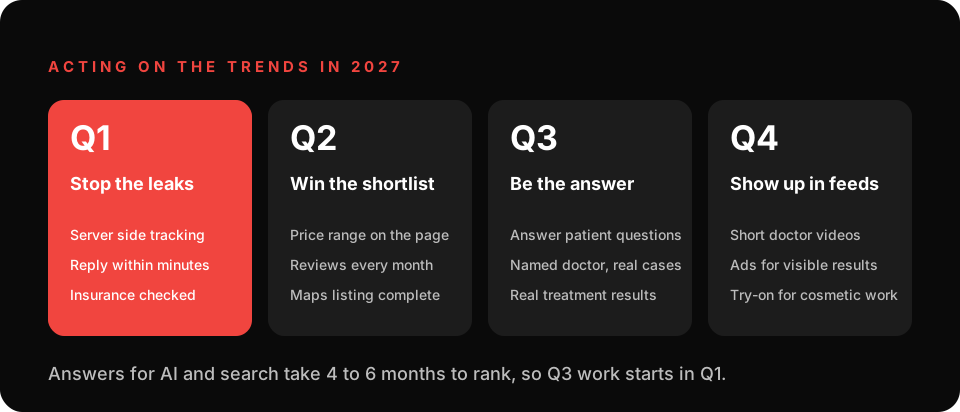
Tracking and follow up come first because they affect every patient you’re already paying for. Answers for AI and search take 4 to 6 months to rank in a mildly competitive market, so they need to start early even though they pay later.
What we’d ignore
Anything that adds a channel before the first one books. A new platform every quarter means none of them gets enough budget to learn who books. We’d also skip publishing piles of generic AI written articles. Google wants health content to be accurate and consistent with expert consensus, and a page nobody at the practice would put their name to won’t help you with patients either.
See which of these is costing you patients.
Six questions, then learn about the marketing opportunities in your area, including where your tracking and follow up stand.
Get your assessment →