Digital Marketing for Healthcare: The Practice Guide
Nine pieces make up a practice’s digital marketing. Here’s what each one does, when it’s worth adding, and the order we build them in.
Ask a practice owner what digital marketing for healthcare includes and you’ll get a long list: ads, SEO, social, email, reviews, a new website. All of it is real. The trouble is that most practices buy it all at once, or in whatever order the sales calls came in, and then can’t tell which part brought anyone through the door. Digital marketing for healthcare that builds in order fixes that.
So this guide goes through each piece, what it actually does for a practice, and the order we build them in. Which ad platform suits your specialty is a separate question, and the answer sits with healthcare lead generation by treatment and town.
Why digital marketing is important in healthcare
Because that’s where patients make up their minds now. Someone with a problem searches it, asks an AI, scrolls past a video, reads the reviews on a Maps listing, and only then calls. By the time they speak to your front desk, they’ve usually already picked you, or already picked someone else.
Referrals and word of mouth still matter. But the referred patient looks you up too. If what they find is an old website and a handful of reviews from years ago, the referral starts to wobble. So your online presence is the version of the practice most people meet first, and it’s doing that job whether anyone looks after it or not.
What each piece does for a practice
Each piece has one job. Some get you found, some get you chosen once you’re on the shortlist, and some bring the patient back. Practices get into trouble when they ask a piece to do a job it was never built for, like expecting SEO to fill next week’s diary or social ads to win a comparison.
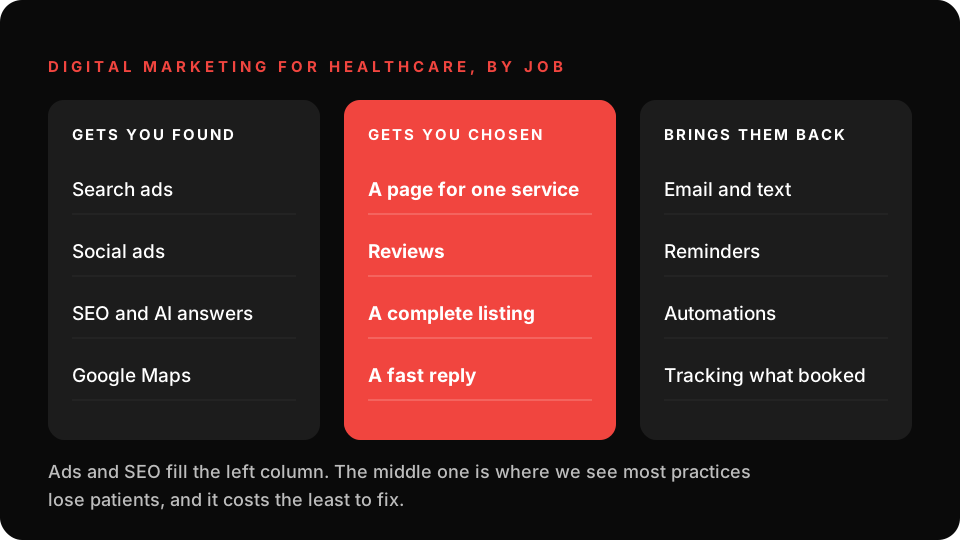
Look at the middle column. The pieces that get you chosen cost very little next to ads, and they make every ad dollar work harder. That’s why they come first, even though they’re the least exciting part of the list.
9 pieces of digital marketing for healthcare, in the order to build them
- A page for one service. One treatment, who it’s for, a price range, real results and a call button on the first screen. Every other piece sends people here, so it has to exist before you pay for a single click.
- Google Business Profile and Maps. Every field filled in, the right categories, the service listed, real photos. It’s free, and it’s where a lot of patients decide if you’re worth a call.
- Reviews. Ask every patient, every month, and reply to every review without ever confirming someone was a patient. Google’s own tips on local ranking say more reviews and positive ratings can help, and reviews that name the treatment are the ones patients actually read.
- Search ads. Once the page and the listing are ready, PPC for healthcare on a single service page catches people who are searching right now. This is the piece that books patients in the first week.
- Social ads. Add them when people have the problem but don’t search for the fix, or when the result is something you can show. For some specialties this one jumps ahead of search, and that’s the platform question again.
- SEO and AI answers. Start early, because it takes 4 to 6 months to rank in a mildly competitive market. The same pages feed AI answers, so healthcare branding that shows up in AI answers comes from the same work.
- Email and text follow up. Confirmations, reminders, and a nudge for people who enquired and went quiet, like these healthcare email examples for each stage. It’s the one piece that works on patients you’ve already paid for.
- HIPAA compliant tracking. Server side, with names and procedures kept in your CRM and only neutral events sent to the ad platforms. Without it you can’t tell which piece booked the patient, and healthcare marketing analytics for practices have nothing to work with, and a standard pixel can send far more than you meant it to.
- Automations. Intake, a way to verify insurance before the first call, and a call list sorted by who’s ready. Build these once enquiries are steady, because automating a trickle saves nobody any time.
One note on number eight. We set up the basics of tracking alongside the first ads. It sits near the end because the full version, where bookings and visits get fed back to the platforms, only pays off once there’s enough volume to learn from.
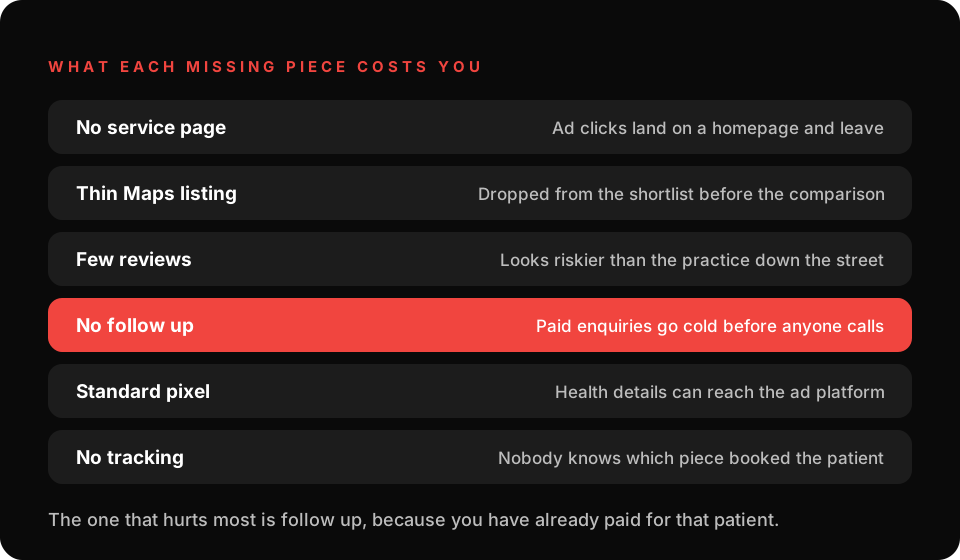
Most practices we meet have search and social ads running and the first three pieces half done. That’s the expensive way round. You pay for the click, the patient lands on a homepage, finds four reviews from 2021, and leaves.
Half the list running and not sure what’s missing?
Let us build it in the right order for you →When each piece starts paying
Ads usually bring bookings in the first week, because they catch people who are already looking. SEO, Google Maps and AI answers take 4 to 6 months to rank in a mildly competitive market. So the ads carry the first months while the slow pieces grow underneath them, and by month six you’re paying for fewer of the patients you get.
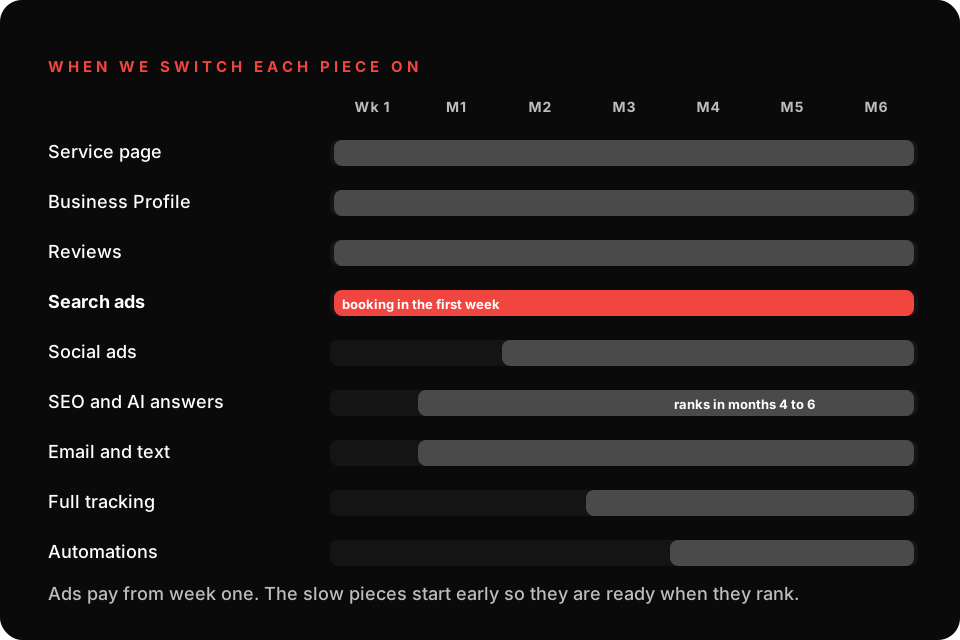
Two pieces move around more than the rest. Social ads move up for treatments people don’t search for, and automations move up for practices that already get more enquiries than the front desk can call back. Everything else tends to follow the order above.
More enquiries than the front desk can call back?
Let us automate the follow up for you →What happens when the order is wrong
We had a colorectal practice getting every patient from its patient acquisition through the referral network and nothing from digital. It had SEO, but the SEO was built around proctology, which barely anyone searches. So it had done piece six first, on the wrong words, and was waiting on it. We put a page and search ads on hemorrhoids and piles, the words patients use, and optimised for booked appointments and calls. Slowly but surely the bookings came in. That’s PPC for healthcare built on the condition doing the job SEO couldn’t do yet.
The opposite case was a fiber supplement brand selling on Amazon. The obvious move was paid social. Instead of that, we started with an email campaign that revived the old customer base, then ran ads on Amazon, where the product is actually bought. That moved it into profit. Follow up to people who already know you is the cheapest piece on the list, so sometimes it jumps the queue.
What it costs to start
The first three pieces cost time more than money. A page, a complete listing and a habit of asking for reviews. Search ads for one service usually need about $1,200 a month in ad spend, and a booking or a call tends to land somewhere between $10 and $50 depending on the area and who else is bidding.
Not sure how to set up search ads for one service?
Let us set up your first campaign →Then you add the next service once the first one books reliably, and revenue per service goes up with each one. If you’re wondering which of these pieces will matter more next year, that’s what healthcare marketing trends for 2027 are about.
Find out which piece your practice is missing.
Six questions, then learn about the marketing opportunities in your area, including which piece we’d build first.
Get your assessment →