21 Healthcare Marketing Ideas That Book Appointments
Small, specific things a practice can do this month to get found, get chosen and get patients back. No awareness fluff.
Most lists of healthcare marketing ideas tell you to “post on social media” and “build your brand”, which is about as useful as telling a patient to “be healthier”. These are the healthcare marketing ideas that come from real campaigns we’ve run for practices: small, specific things you can actually do, each one aimed at getting a booking.
They’re grouped by where they help. Some get you found, some get you chosen over the practice down the road, and some bring patients back.
Before you pick an idea
Don’t try all 21 at once. Pick one service and work through the ideas for that service first. Just make sure it’s the right one, because the wrong treatment turns all 21 ideas into a search for a needle in a haystack. The right one has people looking for it, a good margin, and room in the diary. If you’re confident you know which it is, go ahead and start. Once it books reliably, move to the next. That’s how we grow every practice we work with, and it’s the backbone of a healthcare marketing strategy for one service first.
Not sure which treatment to start with?
Let us find it for you →And decide how you’ll know it worked before you start. Count calls and bookings for that service, not likes or clicks. Healthcare marketing analytics that count bookings will tell you which idea earned its place and which one just looked busy.
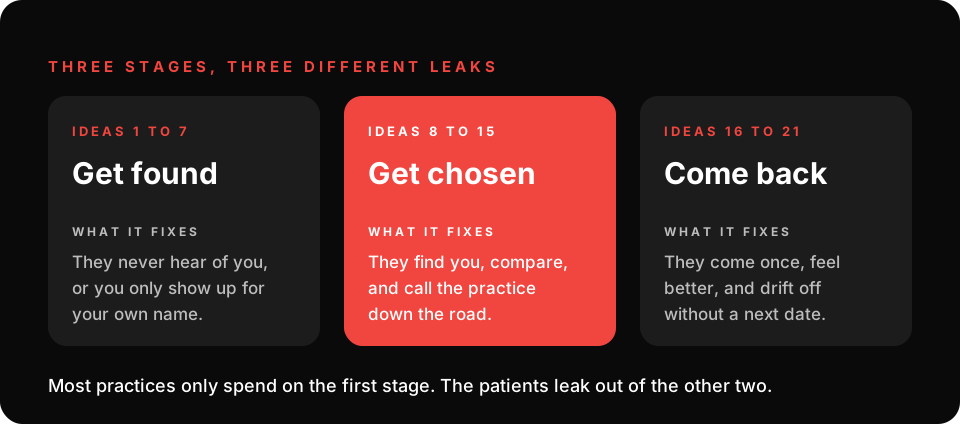
In the list below, ideas 1 to 7 get you found, 8 to 15 get you chosen, and 16 to 21 bring patients back.
21 healthcare marketing ideas that book appointments
- Advertise the condition, in patients’ words. “Hemorrhoids”, not “proctology”: PPC for healthcare written around the condition.
- Fund one service properly. On Google, around $1,200 a month in ad spend is usually enough for one service, which is a healthcare marketing budget that fits a single treatment.
- Give that service its own page. One page per treatment, saying what it is and who it helps in the first two lines. That’s the start of healthcare branding through one page per treatment.
- Fill in every field on Google Maps. Hours, photos, and each treatment listed by name, so you show up when someone searches the treatment and not just your practice name.
- Turn front desk questions into answers. Any question your team hears every week deserves a short written answer on your site. That’s healthcare content marketing built from phone questions.
- Film one short video per question. The doctor, a phone, one question answered in under a minute. Healthcare video marketing that answers one question beats a polished practice tour.
- Go where the worried people are. When few people search your procedure, market the problem behind it on the platform where they spend time. For weight loss surgery, that was healthcare lead generation on Facebook and Instagram.
- Put a price range on the treatment page. “From $X to $Y, depending on” is enough.
- Put a call button on the first screen. On a phone, before any scrolling.
- Say who the treatment is for. And who it isn’t for.
- Ask every patient for a review that names the treatment. Every patient, not just the happy ones: Google’s review content policy bans selectively asking for positive reviews.
- Offer a 10 minute taste of a device treatment. A short mini session lets people feel it, and they remember where they first did. It’s how the healthcare marketing campaigns with a sampling bus won patients from nearby providers.
- Let them see it on themselves. For cosmetic work, an AI try-on for cosmetic procedures gives people something to picture while they decide.
- Check insurance before they ask. Insurance verification before the first visit takes the surprise out of the front desk.
- Mystery shop your own practice. Call as a patient and ask the price and the first free slot, then fill in your own web form and time the reply. A slow answer is often why Google Ads don’t work for some practices.
- Show patients their own progress. With their consent, put a photo or measurement from the first visit next to today’s at each follow up. It gives them a reason to keep the next appointment.
- Book the next visit before they leave. A date on the calendar beats a promise to call later.
- Send one useful email a month. About their condition or treatment, never practice news. Healthcare email examples patients actually open show the kind that work.
- Win back lapsed patients before buying new ones. Message anyone overdue for a visit before you pay to find strangers. That’s where patient engagement strategies for overdue patients start.
- Tell referring doctors what happened. Patient acquisition from referring doctors runs on that note.
- Give each treatment its own recall date. Time the reminder to when that treatment usually needs a top up or a check, instead of one generic yearly note.
What half of these look like on one page
A lot of the “get chosen” ideas live in one place: the page for that treatment. So if you only fix one page this month, fix that one, top to bottom, on a phone.
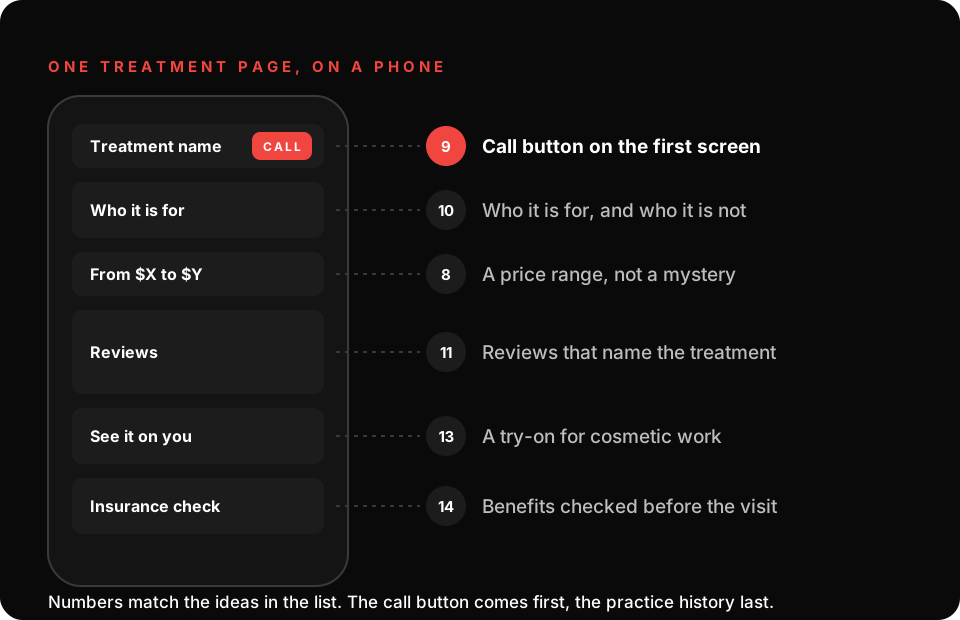
Notice what’s missing: a long history of the practice and a wall of credentials. They matter, but they belong further down, once the patient knows the treatment and the price make sense.
Not sure what your treatment page is missing on a phone?
Let us go through the page for you →How fast each stage pays
The stages don’t pay back at the same speed, which is why the order you do them in matters. Ads usually bring enquiries in the first week. SEO, Google Maps and AI answers take 4 to 6 months to rank in a mildly competitive market. The come back ideas pay whenever a patient is next due.
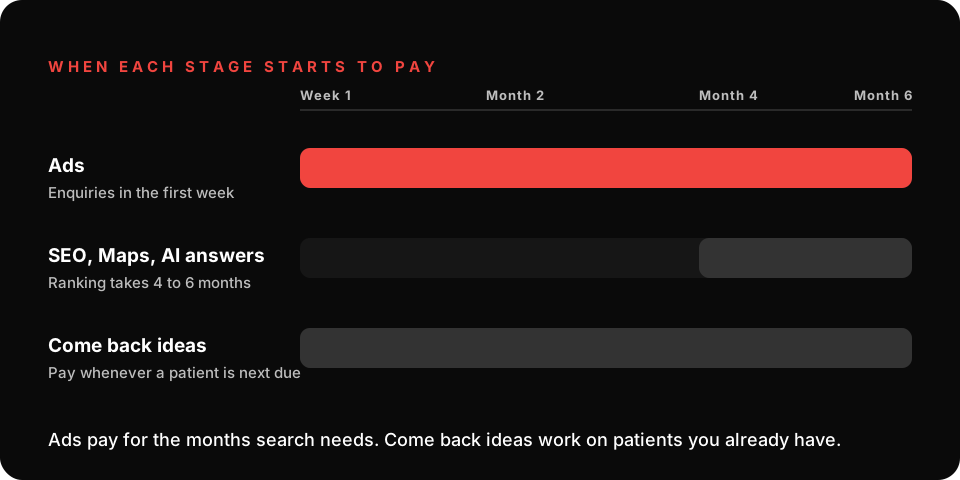
So we run ads on one service first, fix the page so those clicks book, and build the search side underneath while the ads pay for it. On Google, a booking or a call usually costs $10 to $50, depending on your area and who else is bidding.
Ideas we’d leave out
Some popular ideas cost more than they bring in, or cause trouble later. Paying or discounting for reviews is one. Google’s own tips to get more reviews say incentives for reviews count as fake content and aren’t allowed. Just ask, and make it easy.
Dropping an ad platform’s tracking pixel on your booking pages is another. HHS has published guidance on online tracking technologies for covered entities, and a pixel that sends patient details to an ad platform is a problem. We track server side instead, with no PHI going to ad platforms.
Worried a pixel on your booking page sends patient details?
Let us check your tracking for you →And generic awareness posts with no treatment, no price and no next step. They fill a calendar, but nobody books from them.
Find out which ideas your practice needs first.
Six questions, then see where you lose patients today: getting found, getting chosen, or getting them back.
Get your assessment →